


Stainless Steel Coil · In-Stock Supplier
If you are looking for a reliable stainless steel coil supplier to meet the requirements of industrial, automotive, food processing, chemical, and construction applications, GNEE provides a full range of stainless steel coils, including 201 / 304 / 316L / 430 / 409 grades in both cold rolled and hot rolled finishes. With stable inventory, customized services such as coil slitting, leveling, and surface treatment, we provide one-stop processing solutions to global customers. Supported by an ISO 9001 quality management system, our stainless steel coils are exported to 60+ countries worldwide. Through consistent quality, competitive pricing, and dependable delivery, we help customers reduce procurement risks and improve supply efficiency.


1. Overview of Stainless Steel Coils
Stainless steel coils are divided into austenite, ferrite, martensite, duplex (ferrite-austenite) stainless steel cold rolled coils and stainless steel hot rolled coils.
Coiled materials and plates are actually the same, they just come out of the factory in different forms. Coiled materials come in rolls, while plates come out one by one. If they come out of the factory as plates, they are also called original plates, which are usually thick plates. If they are very thick, they cannot be rolled. Generally, they cannot be rolled if they are thicker than 16 mm.

Our Products
GNEE provides a comprehensive range of stainless steel coils for industrial, automotive, food processing, chemical, energy, and construction applications. Our product range covers cold rolled stainless steel coils and hot rolled stainless steel coils, including common grades such as 304/304L, 316/316L, 321/321H, 309S, 310S, 904L, 2205 duplex stainless steel, 201, 410, 420, 430, and 409/409L. We supply coils in thicknesses from 0.2 mm to 100 mm, widths from 600 mm to 2000 mm, with surface finishes including 2B, BA, No.1, No.4, HL, 8K mirror, and brushed finishes. All coils are produced according to ASTM, ASME, EN, JIS, and GB standards, with full traceability from raw material to shipment.


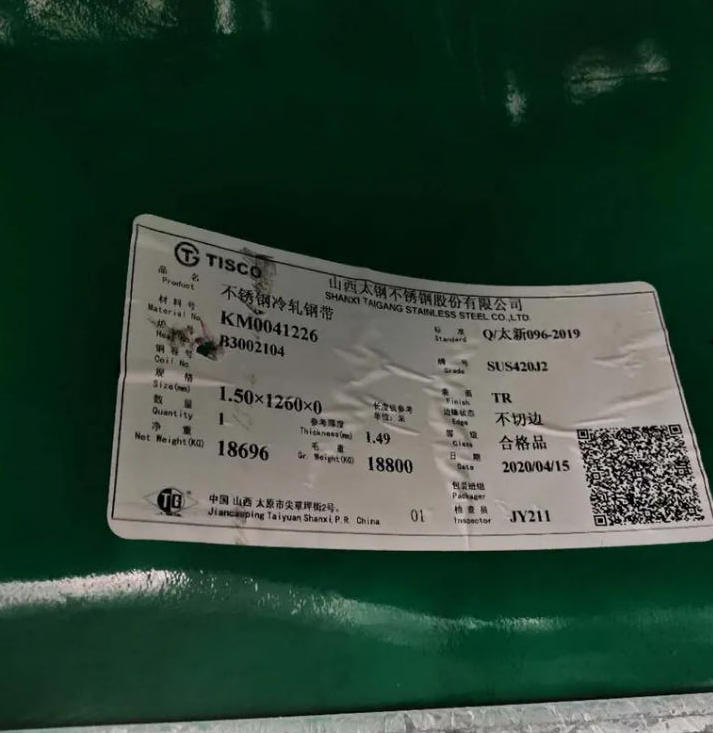

Stainless Steel Coil Specification
| Item | Specification |
|---|---|
| Grade | 201 / 304 / 304L / 316 / 316L / 430 / 409 / 410 / 904L, etc. |
| Cold Rolled Thickness | 0.25 mm — 6.0 mm (Common stock sizes: 0.3 / 0.5 / 0.8 / 1.0 / 1.2 / 1.5 / 2.0 / 3.0 mm) |
| Hot Rolled Thickness | 3.0 mm — 12.0 mm (Common stock sizes: 3.0 / 4.0 / 5.0 / 6.0 / 8.0 / 10.0 mm) |
| Width Range | 1000 mm / 1219 mm / 1250 mm / 1500 mm / 1524 mm (Custom slitting widths available from 20 mm and above) |
| Coil Weight | 3 — 25 MT per coil (Customized coil weight available according to customer requirements) |
| Surface Finish | 2B / BA / No.1 / HL (Hairline) / 8K Mirror / Embossed / Sandblasted / Titanium Coated / Black Titanium Finish |
| Edge Type | Slit Edge / Mill Edge |
| Applicable Standards | ASTM A240 / JIS G4305 / EN 10088 / GB/T 3280 / GB/T 4237 (Production according to customer-specified standards available) |
| Packaging | Export standard packing: wooden pallet + steel strip fastening + waterproof film wrapping (Wooden cases or steel frames available upon request) |
| Quality Documents | Material Test Certificate (MTC) / Certificate of Origin (CO) / FORM E / FORM A / SGS Inspection Report (Available upon request) |
Standards
| Standard | Region |
| ASTM A240 | North America (composition, mechanical, testing) |
| JIS G 4304 / G 3463 | Japan |
| GB/T 3280-2015 | China (cold rolled plate & strip) |
| EN 10088-2 | Europe |
| DIN / AISI / SUS | Germany / US / Japan (grade designation) |
Chemical Composition (wt. %)
| Element | 201 | 304 / 304L | 316 / 316L | 430 | 2205 |
| C (max) | 0.15 | 0.07 / 0.03 | 0.07 / 0.03 | 0.08 | 0.03 |
| Cr | 16.0 – 18.0 | 18.0 – 20.0 | 16.0 – 18.0 | 16.0 – 18.0 | 22.0 – 23.0 |
| Ni | 3.5 – 5.5 | 8.0 – 10.5 | 10.0 – 14.0 | ≤ 0.75 | 4.5 – 6.5 |
| Mo | — | — | 2.0 – 3.0 | — | 3.0 – 5.0 |
| Mn (max) | 6.0 | 2.0 | 2.0 | 1.0 | 2.0 |
| Si (max) | 1.0 | 0.75 | 0.75 | 1.0 | 1.0 |
| P (max) | 0.06 | 0.045 | 0.045 | 0.045 | 0.030 |
| S (max) | 0.03 | 0.03 | 0.03 | 0.03 | 0.02 |
Mechanical Properties (Annealed, per ASTM A240)
| Grade | Yield Strength Rₚ₀.₂ (MPa) | Tensile Strength Rₘ (MPa) | Elongation (%) | Hardness (HV) | Hardness (HRB) |
| 201 | ≥ 275 | ≥ 520 | ≥ 35 | ≤ 260 | ≤ 101 |
| 202 | ≥ 275 | ≥ 520 | ≥ 40 | ≤ 218 | ≤ 95 |
| 301 | ≥ 205 | ≥ 520 | ≥ 40 | ≤ 200 | ≤ 90 |
| 304 | ≥ 205 | ≥ 515 | ≥ 40 | ≤ 210 | ≤ 92 |
| 304L | ≥ 205 | ≥ 520 | ≥ 40 | ≤ 200 | ≤ 90 |
| 316L | ≥ 177 | ≥ 480 | ≥ 40 | ≤ 200 | ≤ 90 |
| 430 | ≥ 206 | ≥ 450 | ≥ 22 | ≤ 200 | ≤ 88 |
| 410S | ≥ 205 | ≥ 440 | ≥ 20 | ≤ 210 | ≤ 92 |
| 420J2 | ≥ 225 | ≥ 540 | ≥ 18 | ≤ 180 | ≤ 80 |
| 2205 | ≥ 450 | ≥ 620 | ≥ 25 | ≤ 293 | ≤ 30 |
| 2507 | ≥ 450 | ≥ 620 | ≥ 25 | ≤ 290 | ≤ 30 |
| 904L | ≥ 216 | ≥ 490 | ≥ 35 | — | ≤ 90 |
| 253MA | ≥ 310 | ≥ 600 | ≥ 40 | ≤ 217 | ≤ 95 |
| 254SMO | ≥ 300 | ≥ 650 | ≥ 35 | ≤ 223 | ≤ 96 |
Stainless Steel Coil Thickness Tolerance
(According to ASTM A480 / EN 10051 / JIS G4305 standards, tolerance depends on grade, width, and production process.)
| Thickness Range | Cold Rolled Coil Thickness Tolerance | Hot Rolled Coil Thickness Tolerance | Applicable Standards |
|---|---|---|---|
| 0.20 – 0.40 mm | ±0.025 mm | — | ASTM A480 / EN 10140 |
| 0.40 – 0.60 mm | ±0.030 mm | — | ASTM A480 |
| 0.60 – 1.00 mm | ±0.040 mm | — | ASTM A480 |
| 1.00 – 1.50 mm | ±0.050 mm | ±0.12 mm | ASTM A480 / EN 10051 |
| 1.50 – 2.00 mm | ±0.060 mm | ±0.15 mm | ASTM A480 |
| 2.00 – 3.00 mm | ±0.070 mm | ±0.18 mm | ASTM A480 |
| 3.00 – 5.00 mm | ±0.10 mm | ±0.20 mm | ASTM A480 / EN 10051 |
| 5.00 – 8.00 mm | — | ±0.25 mm | EN 10051 |
| 8.00 – 12.00 mm | — | ±0.30 mm | EN 10051 |
| 12.00 – 20.00 mm | — | ±0.40 mm | EN 10051 |
| 20.00 – 50.00 mm | — | ±0.50 mm | Hot Rolled Plate/Coil Standard |
Stainless Steel Coil Width Tolerance
| Nominal Width | Cold Rolled Coil Width Tolerance | Hot Rolled Coil Width Tolerance | Edge Type |
|---|---|---|---|
| ≤600 mm | ±0.5 mm | ±1.0 mm | Slit Edge / Mill Edge |
| 600 – 1000 mm | ±0.7 mm | ±1.5 mm | Slit Edge / Mill Edge |
| 1000 – 1250 mm | ±1.0 mm | ±2.0 mm | Standard Coil Width |
| 1250 – 1500 mm | ±1.5 mm | ±2.5 mm | Heavy Gauge Coil |
| 1500 – 2000 mm | ±2.0 mm | ±3.0 mm | Wide Coil |
Stainless Steel Coil Length Tolerance (Cut-to-Length)
| Cutting Length | Standard Length Tolerance | Precision Cutting Tolerance |
|---|---|---|
| ≤1000 mm | ±1.0 mm | ±0.5 mm |
| 1000 – 3000 mm | ±2.0 mm | ±1.0 mm |
| 3000 – 6000 mm | ±3.0 mm | ±1.5 mm |
| >6000 mm | ±5.0 mm | According to customer drawing |
Stainless Steel Coil Flatness Tolerance
| Product Type | Flatness Requirement | Typical Tolerance |
|---|---|---|
| Cold Rolled 2B Coil | Standard Flatness | ≤8 mm / 2000 mm |
| Cold Rolled BA Coil | Improved Flatness | ≤5 mm / 2000 mm |
| Precision Cold Rolled Coil | High Flatness | ≤3 mm / 2000 mm |
| Hot Rolled No.1 Coil | Commercial Flatness | ≤15 mm / 2000 mm |
| Laser Cutting Grade Coil | Premium Flatness | ≤2 mm / 2000 mm |
Stainless Steel Coil Edge Tolerance
| Edge Condition | Specification | Tolerance Requirement |
|---|---|---|
| Mill Edge (No.1 Coil) | Hot rolled original edge | According to ASTM A480 |
| Trimmed Edge |
Mechanical trimming
|
Width tolerance ±1.0 mm |
| Slit Edge | Precision slitting | Burr height ≤0.05 mm |
| Deburred Edge | Smooth processed edge | Burr-free surface |
Stainless Steel Coil Coil ID / OD Tolerance
| Item | Standard Specification | Tolerance |
|---|---|---|
| Inner Diameter (ID) | 508 mm | ±5 mm |
| Inner Diameter (ID) | 610 mm | ±5 mm |
| Outer Diameter (OD) | Customized according to weight | ±10 mm |
| Coil Weight | 1–10 tons typical | ±5% |
Stainless Steel Coil Weight Calculation
Stainless Steel Coil Weight Calculation Formula
The weight of stainless steel coil can be calculated based on the coil thickness, width, length, and stainless steel density.
Formula:
Weight (kg) = Thickness (mm) × Width (mm) × Length (m) × Density ÷ 1,000,000
For stainless steel, the commonly used density is:
Density = 7.93 g/cm³ (7,930 kg/m³)
| T (mm) | W = 1000 mm | W = 1219 mm | W = 1250 mm | W = 1500 mm |
| 0.30 | 1.77 t | 2.16 t | 2.22 t | 2.66 t |
| 0.50 | 2.95 t | 3.60 t | 3.70 t | 4.43 t |
| 0.80 | 4.72 t | 5.75 t | 5.92 t | 7.09 t |
| 1.00 | 5.90 t | 7.19 t | 7.40 t | 8.86 t |
| 1.20 | 7.08 t | 8.63 t | 8.88 t | 10.64 t |
| 1.50 | 8.85 t | 10.79 t | 11.10 t | 13.30 t |
| 2.00 | 11.80 t | 14.38 t | 14.80 t | 17.73 t |
| 2.50 | 14.75 t | 17.98 t | 18.50 t | 22.17 t |
| 3.00 | 17.70 t | 21.57 t | 22.20 t | 26.60 t |
Note: The above figures are estimated based on an OD of 1200 mm; actual coil weight depends on the OD (typical OD range: 800–1500 mm).
Stainless Steel Coil Surface Finish
| Surface Finish | Manufacturing Process | Surface Characteristics | Typical Applications |
|---|---|---|---|
| No.1 | Hot Rolled + Annealed + Pickled | Matte surface, high thickness range | Industrial equipment, tanks, pressure vessels |
| 2B | Cold Rolled + Annealed + Pickled + Skin Passed | Smooth semi-bright surface | General fabrication, food equipment, chemical industry |
| BA | Bright Annealing in Controlled Atmosphere | Mirror-like bright surface | Automotive parts, appliances, decorative applications |
| No.4 | Grinding & Polishing | Brushed finish | Kitchen equipment, elevators, architectural panels |
| HL (Hairline) | Continuous Brushing | Long linear satin finish | Decorative panels, building facades |
| 8K Mirror | Multi-step Polishing | High reflective mirror surface | Luxury decoration, stainless steel furniture |

GNEE Stainless Steel Coil Export Order References
With stable production capacity, strict quality control, and export experience to 60+ countries, GNEE supplies stainless steel coils for demanding industries worldwide, providing traceable materials, customized dimensions, and reliable delivery solutions.
| No. | Export Country | Material Grade | Coil Specification (Thickness × Width) | Quantity (MT) | Surface Finish | Application / End Use |
|---|---|---|---|---|---|---|
| 1 | Vietnam | ASTM A240 304 | 1.0 × 1219 mm | 23.6 MT | 2B | Food processing equipment, stainless steel fabrication |
| 2 | South Korea | ASTM A240 316L | 1.5 × 1500 mm | 18.8 MT | 2B | Semiconductor equipment and chemical processing components |
| 3 | Germany | EN 1.4301 (304) | 0.8 × 1250 mm | 21.4 MT | BA | Precision components, industrial machinery covers |
| 4 | United States | ASTM A240 316L | 2.0 × 1500 mm | 24.7 MT | No.1 | Chemical equipment, pressure vessel fabrication |
| 5 | Italy | ASTM A240 430 | 0.6 × 1000 mm | 19.5 MT | 2B | Kitchen appliances and decorative stainless panels |
| 6 | Brazil | ASTM A240 304 | 1.2 × 1500 mm | 22.3 MT | 2B | Metal processing and industrial equipment |
| 7 | Turkey | ASTM A240 321 | 3.0 × 1500 mm | 20.6 MT | No.1 | Heat exchanger and high-temperature equipment |
| 8 | Mexico | ASTM A240 409 | 1.0 × 1219 mm | 25.1 MT | 2B | Automotive exhaust system manufacturing |
| 9 | Saudi Arabia | ASTM A240 316L | 3.0 × 1500 mm | 23.8 MT | No.1 | Oil & gas pipelines and corrosion-resistant structures |
| 10 | UAE | ASTM A240 304 | 1.5 × 1219 mm | 17.9 MT | BA | Architectural decoration and stainless fabrication |


Customer Pain Points and Solutions
We have a deep understanding of the issues that customers are most concerned about when purchasing stainless steel coils and provide targeted solutions.

Inconsistent Quality
Significant fluctuations in material composition across batches and inconsistent mechanical properties impact downstream processing yields and finished product quality.
Batch-Specific Quality Inspection & Certification
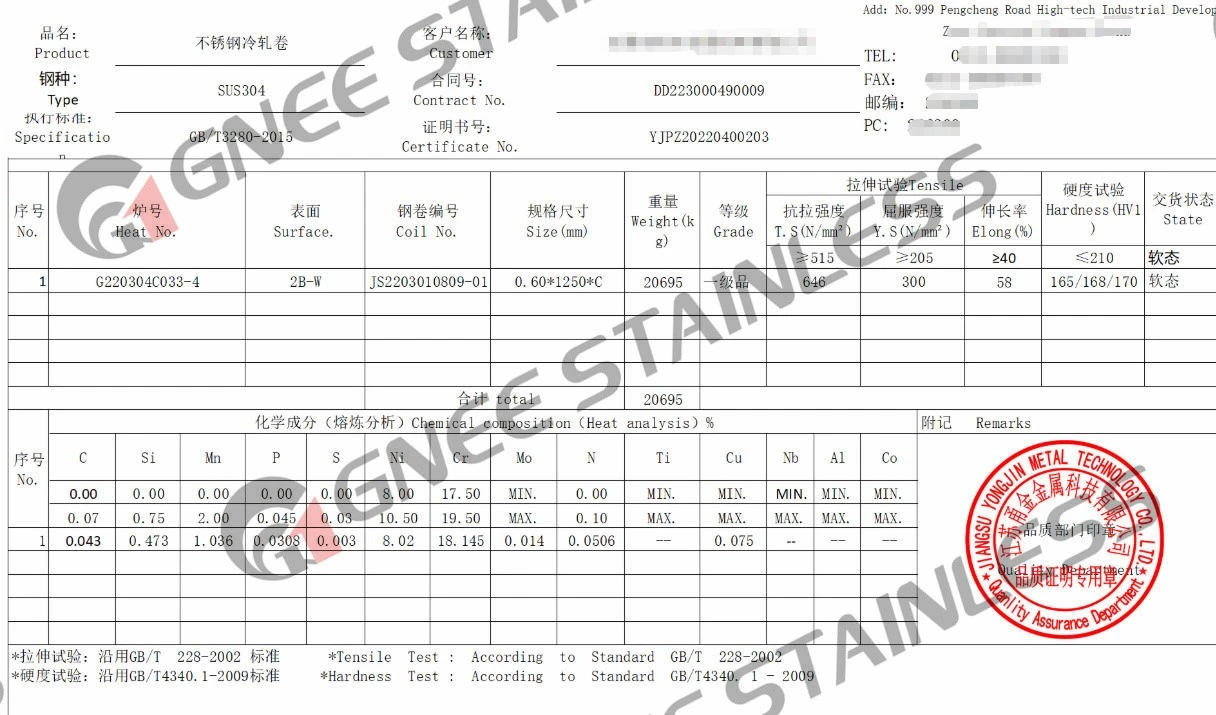
Each batch undergoes spectral composition analysis, mechanical property testing, and hardness checks prior to shipment; a comprehensive MTC (Material Test Certificate) is provided, ensuring compositional tolerances remain within standard limits.
Surface Scratches/Blemishes
Surface scratches, indentations, or oxidation occurring during transit can lead to material downgrading or even scrapping, resulting in significant losses for the customer.
100% Surface Inspection & Protective Film
Surface quality is inspected for every coil prior to shipment; a PE protective film is applied during packaging, and the coils are secured on wooden pallets with steel strapping to ensure damage-free transport.


Specification Mismatch
Standard widths or thicknesses may not meet requirements, necessitating the outsourcing of slitting and cut-to-length processing—which increases communication costs and material loss during transport.
In-House Custom Slitting and Cut-to-Length
Equipped with our own slitting and cut-to-length lines, we offer customization of widths (starting from 20mm) and lengths to meet specific customer needs, delivering finished products in a one-stop process and eliminating the need for secondary processing.
Our Factory
GNEE maintains a large inventory of standard specification stainless steel coils, including 304, 316, and 430 series, in warehouses located in Anyang, Tianjin, and near major ports throughout the year. The shortest delivery time can be reduced to 7-15 days.
Our slitting and cut-to-length processing are completed using precision slitting lines and shearing machines, with an accuracy of up to ±0.01mm. Every batch of raw materials must undergo strict inspection before shipment. We provide original Mill Test Certificates (MTC) and support independent inspections by third-party organizations such as SGS, BV, and TUV to ensure that the chemical composition and mechanical properties fully comply with international standards.


Quality Inspection
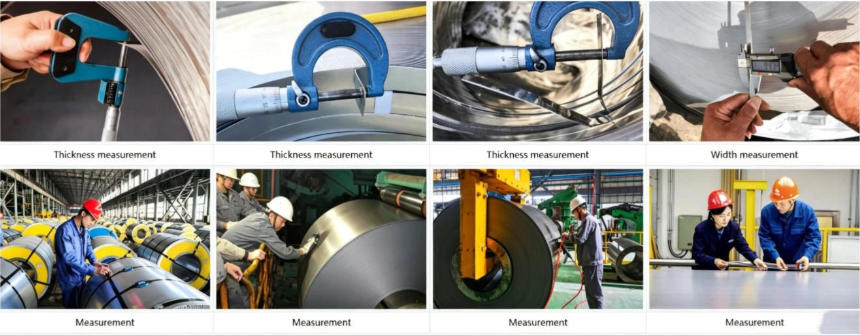
GNEE performs comprehensive quality inspections for every stainless steel coil before shipment, including chemical composition analysis (PMI/spectrometer), mechanical property testing (tensile strength, yield strength, elongation), thickness and width tolerance inspection, surface quality inspection, hardness testing, corrosion resistance testing, and dimensional verification. Each coil is traceable by heat number and supplied with EN 10204 3.1 MTC, ensuring full records of chemical composition, mechanical performance, and production inspection data for global projects.
Standard export packaging
1. Packaging Layers
Anti-rust protection: Surface coated with light anti-rust oil (optional) and wrapped in anti-rust paper (VCI paper).
Waterproof layer: Inner layer wrapped in high-strength waterproof plastic sheeting to prevent salt spray corrosion during sea transport.
Outer protection: Outer layer covered with galvanized steel sheets or cardboard, secured with high-strength steel strapping (typically in a 3x3 or 4x4 pattern) applied both longitudinally and transversely.
2. Packaging Configuration
Vertical packaging ("Eye to Sky"): Coil eye facing upward; suitable for thinner, narrower precision strip materials.
Horizontal packaging ("Eye to Wall"): Coil eye positioned horizontally; the most common logistics packaging method for large stainless steel coils, facilitating forklift handling and lifting operations.


For international shipping, buyers usually consider:
| Container Type | Maximum Loading Weight | Typical Stainless Steel Coil Quantity |
|---|---|---|
| 20 GP Container | 20–25 MT | 1 large coil or several small coils |
| 40 GP Container | 25–26 MT | 1–3 coils |
| 40 HC Container | 25–26 MT | Multiple coils |
FAQ
Q: What is the difference between cold-rolled (CR) and hot-rolled (HR) coils?
A: Hot-rolled: Rough surface, lower dimensional accuracy, thickness of 3–14 mm; suitable for structural components. Cold-rolled: Smooth surface, high dimensional accuracy, thickness of 0.15–3.0 mm; suitable for aesthetic parts and precision machining.
Q: Why is there a price difference of approximately 25% between 304 and 316?
A: The key difference is the molybdenum (Mo) content (2–3%), which significantly enhances resistance to chloride-induced pitting corrosion. 316 is preferred for coastal or chemical industry projects.
Q: Are 201 and 304 interchangeable?
A: Not recommended. 201 has lower Cr/Ni content and significantly weaker corrosion resistance than 304; it is unsuitable for humid, food-contact, or chemical environments.
Q: What is the difference between Mill Edge and Slit Edge?
A: Mill Edge: The natural edge from the rolling mill; slightly uneven. Slit Edge: Precision-cut by a slitter; width tolerance of ±0.1 mm; suitable for automated production lines..
Q: What is the minimum order quantity (MOQ)?
A: The MOQ for standard stock specifications is 1 ton, while the MOQ for custom slitting or special specifications is 3–5 tons. New clients may place a small trial order first; bulk cooperation can be established once the quality is approved. Free samples are available (freight collect) for material testing.
Q: What is the typical delivery lead time?
A: Stock items: Shipped within 3–7 days of order placement. Custom slitting/leveling and cutting: Delivered within 7–15 days. Rush orders can be shipped within 3 days (depending on specifications and quantity). Delivery dates are stipulated in the contract; compensation will be provided in accordance with the contract terms if delays occur due to our fault.
Q: Can you provide samples for testing?
A: Yes. We provide small samples (approx. 150×150mm) free of charge for testing material composition, mechanical properties, and surface quality (freight collect). Larger samples can be provided at cost price.
Q: What certifications do you hold?
A: Our factory is ISO 9001 certified, and our products comply with international standards such as ASTM, JIS, EN, and GB. We can provide third-party inspection reports from SGS or BV. For exports, we supply Certificates of Origin (CO) and preferential certificates (such as FORM E or FORM A) to help customers benefit from tariff reductions.
Q: Can you provide custom-specification slitting and cut-to-length services?
A: Yes. We operate our own slitting and cut-to-length lines, allowing us to customize slit widths (minimum 20mm) and cut lengths (maximum 12 meters) according to customer requirements. Processing precision: width tolerance ±0.1mm, length tolerance ±2mm, and shearing burr height ≤ 0.05mm.
Q: What are the packaging and logistics arrangements?
A: Standard packaging: Coils are lined with moisture-proof paper, wrapped in PE protective film, secured with plastic-steel strapping, and placed on wooden pallets. For expedited export shipments, additional wooden crating or steel framing is available. Logistics options include sea freight (FCL/LCL), road transport, and rail transport; we can handle booking and customs clearance, or work with a freight forwarder designated by the customer.
Q: What are the available payment methods?
A: We accept various payment methods, including T/T (30% deposit + 70% balance against a copy of the Bill of Lading), L/C (at sight or usance), and D/P. Long-term partners may apply for a credit line with monthly settlement.
Q: What should I do if there are quality issues upon receipt?
A: Please inspect the outer packaging and surface condition immediately upon delivery; if any issues are found, please take photos for your records and contact us. If the issue is confirmed to be a manufacturing defect (such as non-compliant material, surface flaws, or dimensional deviations), we offer a return or exchange within 7 days, with all round-trip shipping costs covered by us. A Material Test Certificate (MTC) is included with every batch, ensuring traceability back to the raw material heat number.
Gnee Steel (Tianjin) Co., Ltd. is well-known as one of the leading stainless steel coil manufacturers and suppliers in China. Our factory offers customized stainless steel coil made in China with competitive price. Welcome to contact us for wholesale service.
stainless steel round coil, stainless steel coil large quantity coil, stainless steel coil polyurethane coated coil