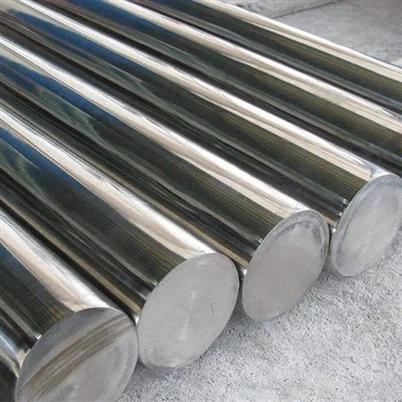
Is 316L Stainless Steel Pipe Magnetic? Causes, Effects and Test Methods
Leave a message
Why Austenitic Pipe Is Non-Magnetic in the First Place
Stainless steel pipe is grouped by microstructure into austenitic, ferritic, martensitic and duplex families, and only the ferritic and martensitic structures are ferromagnetic. 316L is a fully austenitic grade, derived from the 18-8 family with molybdenum added for pitting resistance, with a carbon limit of 0.030 % that keeps the structure stable and weldable. In the annealed and solution-treated condition its face-centred cubic austenite is paramagnetic, which means it is theoretically and practically non-magnetic, with a relative permeability close to 1.
How Magnetism Appears in 316L Pipe
Three mechanisms explain almost every case of magnetic 316L pipe.
The first and most common is cold work. Drawing, pilgering, straightening, bending and thread rolling generate dislocations and stacking faults in the austenite; in a low-nickel, low-molybdenum austenitic matrix this encourages a partial transformation to body-centred deformation martensite, often called strain-induced alpha-prime martensite. The affected zones are strongly magnetic, and the more the material is cold reduced, the greater the effect.
The second is welding. Weld metal solidifies directly from the melt and its composition is shifted by segregation, so a small amount of delta ferrite remains in the as-welded structure. Delta ferrite is magnetic. Its content is expressed as ferrite number and is intentionally controlled within a narrow range in some product specifications because it reduces hot cracking susceptibility.
The third is chemistry drift. A heat at the low end of the nickel range, or with a chromium-to-nickel ratio towards the upper limit, has a less stable austenite and will transform more readily under the same deformation.
Does Magnetism Mean the Pipe Is Defective?
| Condition | Typical cause | Practical meaning |
|---|---|---|
| Annealed tube, slight attraction | Light straightening, residual stress | Acceptable for most services |
| Cold drawn heavy section, strong attraction | Strain-induced martensite | Check corrosion and impact requirements |
| Attraction localised near the weld | Delta ferrite in weld metal | Normally acceptable; verify by weld procedure |
| Uniform attraction across a full length | Wrong grade or heat treatment not applied | Verify chemistry and test certificate |
Magnetism itself does not reduce corrosion resistance, does not change pressure capability, and is not a defect in the sense of a specification violation. What it can do is affect magnetic particle inspection, interfere with instruments, and produce force effects in magnetic bearings or in equipment near strong fields. It also indicates that cold work has been applied, and heavy cold work reduces ductility and can lower resistance to stress corrosion cracking in chloride service.
Permeability Values and Test Methods
Permeability is expressed as relative permeability, the ratio of the material permeability to that of free space. For annealed austenitic pipe, values just above 1 are normal; instrument-grade and low-field applications commonly specify a limit of about 1.02 in the annealed condition. Permeability of weakly magnetic materials is measured by the methods of ASTM A342, which includes the use of a magnetic permeability indicator and low-field measurement techniques. Ferrite content in austenitic weld metal is usually estimated from the chemical composition using the WRC-1992 constitution diagram or measured directly with a ferrite indicator, expressed in ferrite number rather than percent.
Controlling Magnetism in Production
When non-magnetic behaviour matters, the practical controls are to order a heat with balanced nickel content above the mid-range, to minimise cold reduction and avoid excessive straightening, and to carry out a final solution annealing treatment at a suitable austenitising temperature followed by rapid cooling, which reverses the strain-induced martensite and restores a fully austenitic structure. On the fabrication side, using filler metal that produces a low ferrite number, and choosing low-heat-input welding procedures, keeps the weld zone response as low as possible. Where residual magnetism interferes with welding arc stability, it can be reduced by demagnetising before fabrication rather than by rejecting material.
Frequently Asked Questions
Q: Is 316L stainless steel pipe magnetic?
A: In the annealed condition it is essentially non-magnetic. It can become weakly to moderately magnetic after cold working, and locally magnetic near a weld, because of strain-induced martensite and delta ferrite.
Q: Does a magnet sticking to 316L mean it is not 316L?
A: Not on its own. Verify the heat number and certificate, and check whether the attraction is local or general. A strong, uniform response across a full length is a stronger warning than a weak pull on a formed part.
Q: Does magnetism reduce corrosion resistance?
A: Magnetism as such does not. However, the cold work that creates it can reduce ductility and increase susceptibility to chloride stress corrosion cracking, so severely cold worked pipe should be reviewed against the service conditions.
Q: How is permeability measured?
A: ASTM A342 describes the accepted test methods for the permeability of weakly magnetic materials, and ferrite content in austenitic weld metal is estimated from the WRC-1992 constitution diagram or measured with a ferrite indicator.
Q: Can magnetic 316L pipe be restored to a non-magnetic condition?
A: Yes, by solution annealing followed by rapid cooling, which removes strain-induced martensite. Dimensions and surface finish must be re-verified after the treatment.
Q: Does 316L remain non-magnetic after welding?
A: The base metal does. The weld metal usually contains a small amount of delta ferrite and can be slightly magnetic, which is normal and does not indicate a defective weld.