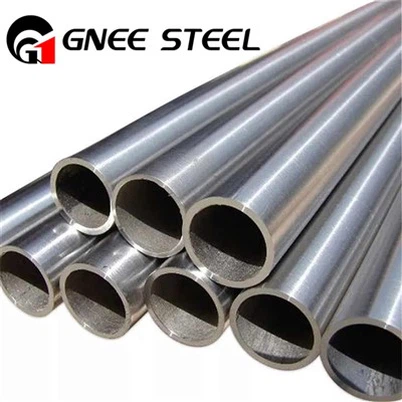
AISI 321 Stainless Steel Pipe Properties & Specifications
Leave a message
1. What Is AISI 321 Stainless Steel Pipe?
AISI 321 stainless steel (UNS S32100) is a titanium-stabilized austenitic grade derived from 304. Titanium is added at a minimum of 5 times the carbon plus nitrogen content (and not more than 0.70%) so that carbon is bound as stable titanium carbides instead of chromium carbides. This prevents chromium depletion at grain boundaries during exposure to the sensitization temperature range, roughly 430-870 deg C, which is commonly encountered during welding or elevated-temperature service. As a result, 321 pipe offers reliable resistance to intergranular corrosion in applications where 304 cannot be safely used.
Three designations appear in procurement documents. AISI 321 and 321H refer to the wrought grades defined in ASTM A240/A240M (plate, sheet and strip) and ASTM A276/A276M (bars). TP321 and TP321H are the pipe designations of ASTM A312/A312M, the governing standard for seamless and welded austenitic stainless steel pipe. Grade 321H carries a controlled carbon range of 0.04-0.10%, which improves creep strength and stress-rupture resistance above roughly 540 deg C. TP321H is therefore preferred for superheater and boiler piping where long-term elevated-temperature strength is the deciding factor.
2. Chemical Composition of AISI 321 / TP321
The composition below follows ASTM A240/A240M for wrought plate and sheet and ASTM A312/A312M for pipe. Limits are maximum values unless a range is shown.
| Element | 321 (UNS S32100) | 321H (UNS S32109) | TP321 (ASTM A312) |
|---|---|---|---|
| Carbon, C | 0.08 max | 0.04-0.10 | 0.08 max |
| Silicon, Si | 0.75 max | 0.75 max | 1.00 max |
| Manganese, Mn | 2.00 max | 2.00 max | 2.00 max |
| Phosphorus, P | 0.045 max | 0.045 max | 0.045 max |
| Sulfur, S | 0.030 max | 0.030 max | 0.030 max |
| Chromium, Cr | 17.0-19.0 | 17.0-19.0 | 17.0-19.0 |
| Nickel, Ni | 9.0-12.0 | 9.0-12.0 | 9.0-12.0 |
| Nitrogen, N | 0.10 max | 0.10 max | 0.10 max |
| Titanium, Ti | 5x(C+N) min, 0.70 max | 4x(C+N) min, 0.70 max | 5x(C+N) min, 0.70 max |
3. Physical and Mechanical Properties
Physical properties
Density: 7.9 g/cm3 (0.29 lb/in3)
Melting range: 1400-1425 deg C (2550-2600 deg F)
Elastic modulus: 193 GPa at 20 deg C
Thermal conductivity: 16.1 W/m.K at 100 deg C; 22.2 W/m.K at 500 deg C
Mean coefficient of thermal expansion: 16.6 x 10⁻⁶/K (0-100 deg C); 18.6 x 10⁻⁶/K (0-538 deg C)
Electrical resistivity: 0.72 micro-ohm.m at 20 deg C; magnetic permeability approximately 1.02
Mechanical properties per ASTM A312/A312M
| Product form | Tensile strength, min | 0.2% yield strength, min |
|---|---|---|
| Welded pipe (all thicknesses) | 515 MPa (75 ksi) | 205 MPa (30 ksi) |
| Seamless, wall up to 9.50 mm (0.375 in) | 515 MPa (75 ksi) | 205 MPa (30 ksi) |
| Seamless, wall over 9.50 mm | 485 MPa (70 ksi) | 170 MPa (25 ksi) |
4. Heat Treatment and Fabrication
Solution annealing of TP321 and 321 wrought product is carried out at a minimum of 1040 deg C (1900 deg F) followed by rapid cooling. Cold-worked 321H requires a minimum annealing temperature of 1095 deg C (2000 deg F), while hot-finished 321H is annealed at a minimum of 1050 deg C (1925 deg F).
Stress-relief practice depends on the objective. For dimensional stability after machining, heat to 205-480 deg C (400-900 deg F) and slow cool at about 4 h per inch of section. After severe forming, full annealing at 1065-1120 deg C (1950-2050 deg F) with slow cooling restores corrosion resistance. Where only peak stresses must be removed, stress relieve below 480 deg C (900 deg F). Typical forging temperature is 925-1260 deg C (1700-2300 deg F).
SS321 and TP321 have excellent weldability and normally require no preheat. Filler metal should have a composition similar to the base metal with a slightly higher alloy content; recommended fillers are 321, 347 and 348, with electrodes E347 or E308L where the service temperature stays below 370 deg C (700 deg F). Keep heat input low and aim for a fine grain size with at least 5% ferrite in the heat-affected zone to avoid liquation cracking.
5. Applications of 321 Pipe
Boiler and superheater tubing, expansion joints and bellows exposed to cyclic high temperatures
Heat exchangers in oil refining and petrochemical plants handling corrosive process streams
Exhaust manifolds, jet engine parts and aircraft ducting
Chemical processing equipment where the sensitization risk rules out 304
For buyers, the practical selection rule is: choose 321H when creep strength above 540 deg C drives the design, and standard 321 when corrosion resistance after welding is the main concern. Confirm the governing standard (A312, A240, EN 10216-5 or GB/T 14976) with the supplier and request the mill test certificate before dispatch.
6. FAQ
What is the difference between 321 and 321H?
321H has a controlled carbon content of 0.04-0.10% versus 0.08% maximum for 321. The higher carbon, combined with titanium stabilization, raises creep strength and stress-rupture life at service temperatures above about 540 deg C.
Does 321 stainless steel pipe require post-weld heat treatment?
No. The titanium addition prevents chromium carbide precipitation in the heat-affected zone, so PWHT is not required for corrosion resistance. If PWHT is nevertheless specified by the design code, it must be performed within the solution-annealing window of 1040-1120 deg C, never in the sensitization range.
What is the EN equivalent of AISI 321 pipe?
EN 10088-2 and EN 10088-3 designate it as X6CrNiTi18-10, steel number 1.4541. The Japanese equivalent is SUS321 (JIS G4304/G4305) and the Chinese equivalent is 06Cr18Ni11Ti (GB/T 3280), UNS S32168 in the new designation.
Which filler metal should be used when welding TP321 pipe?
Use matching stabilized fillers such as 321 or 347, or electrode E347. For service below 370 deg C, E308L is also accepted by many fabricators. The filler should carry a slightly higher alloy content than the base pipe.
Is 321 pipe more expensive than 304 pipe?
Yes. The titanium addition and tighter process control add cost, typically in the range of 5-15% over equivalent 304 product, depending on size and quantity. The premium is justified where intergranular corrosion or elevated-temperature service would otherwise limit service life.