AISI 446 Electropolished Stainless Steel Pipe Guide
Leave a message
What Is AISI 446 Stainless Steel?
AISI 446 is a high-chromium ferritic stainless steel specified as UNS S44600 in ASTM A268 (seamless and welded ferritic pipe and tube) and EN 1.4762 / X10CrAlSi25 in the European system. With 23–27% chromium, it belongs to the heat-resisting ferritic family: it offers outstanding resistance to high-temperature oxidation, thermal fatigue and sulfurous-atmosphere corrosion, with a long-term service temperature up to about 1000°C. The grade is magnetic, has good thermal conductivity and excellent dimensional stability at temperature, and is a cost-effective alternative to austenitic heat-resisting alloys where chlorides are not the dominant corrosive agent.
Chemical Composition (Per ASTM A268, S44600)
| Element | Limit (wt %) |
|---|---|
| Carbon (C) | ≤ 0.20 |
| Manganese (Mn) | ≤ 1.50 |
| Phosphorus (P) | ≤ 0.040 |
| Sulfur (S) | ≤ 0.030 |
| Silicon (Si) | ≤ 1.00 |
| Chromium (Cr) | 23.0 – 27.0 |
| Nickel (Ni) | ≤ 0.75 |
| Nitrogen (N) | ≤ 0.25 |
Mechanical Properties (ASTM A268 Minimums)
| Property | Value |
|---|---|
| Tensile strength | ≥ 485 MPa |
| Yield strength (0.2% proof) | ≥ 275 MPa |
| Elongation (in 50 mm) | ≥ 20% |
| Hardness | ≤ 92 HRB / 201 HB |
| Heat treatment | Annealed at 800 – 900°C, air cooled |
In the annealed condition the material is soft enough to form and weld with proper technique; carbon is kept moderate so that corrosion resistance is not degraded by carbide precipitation.
What Is Electropolishing and Why Use It?
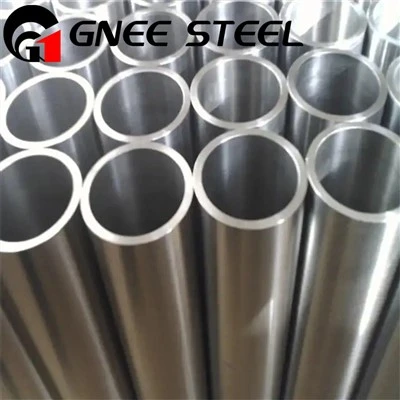
Electropolishing (EP) is an electrochemical process that removes a thin, uniform layer from the metal surface, dissolving microscopic peaks faster than valleys. The result is a smoother, denser surface with Ra 0.2–0.4 μm, a closed and relatively thick chromium oxide film, and no oxide scale or embedded particles. For pipe service the benefits are concrete: reduced fluid friction, easier cleaning, lower risk of deposit accumulation, and better resistance to the onset of localized corrosion. Electropolished 446 is therefore specified for furnace tubes and process lines where surface quality affects flow, cleanliness and service life.
Typical Applications
High-temperature furnace tubes and radiant tubes
Heat exchanger and recuperator tubing
Waste incineration and flue-gas equipment
Pipelines carrying strongly oxidizing chemical media
Glass and ceramics production components requiring oxidation resistance
Selection Notes for Buyers
Confirm the product form: seamless or welded, with OD typically 6–219 mm, wall 0.5–6 mm and lengths 1–6 m as standard ranges.
Specify the finish class (electropolished, bright annealed or pickled) and the required Ra value in the purchase order.
Specify ASTM A268 for pipe and tube and require EN 10204 3.1 mill certificates for chemistry and mechanical traceability.
Remember 446 is magnetic and ferritic; it is not intended for chloride corrosion service where austenitic or duplex grades are required.
Common Misconceptions
"446 is an austenitic stainless steel." No, it is ferritic, magnetic, and cannot be hardened by heat treatment.
"Electropolishing is just polishing." It is an electrochemical removal process that changes surface chemistry and morphology, not a mechanical abrasion step.
"Higher chromium always means better corrosion resistance everywhere." Chromium helps oxidation resistance at high temperature; against chlorides, molybdenum and nickel matter more, which is why 446 is not a seawater grade.
Frequently Asked Questions
What is the European equivalent of AISI 446?
EN 1.4762, steel name X10CrAlSi25, which reflects its chromium, aluminum and silicon content.
Can 446 stainless steel withstand 1000 degrees Celsius?
Yes for long-term service in oxidizing atmospheres; resistance to thermal fatigue and sulfurous gases is a key advantage of the grade.
Is 446 stainless steel magnetic?
Yes, as a ferritic grade it is strongly magnetic.
What surface roughness does electropolishing achieve?
Typically Ra 0.2-0.4 micrometers, with a uniform mirror-like appearance and no oxide residues.
Is 446 suitable for chloride or seawater service?
No. Its high-temperature oxidation resistance does not translate to chloride resistance; use austenitic 316L or duplex grades for chlorides.
Which standard covers 446 pipe?
ASTM A268 covers seamless and welded ferritic stainless steel pipe and tube, with UNS S44600 the standard designation.