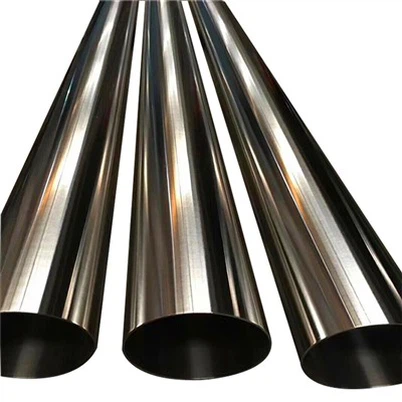
ASTM A213 TP317L Stainless Steel U Bend Tube For Heat Exchanger
Leave a message
Why do U-bends in heat exchangers often become the weakest link-leading to cracking, wall thinning, or installation difficulties-even when high-grade stainless steel materials are specified? The fundamental reason lies in whether the material quality, bending control, heat treatment processes, and dimensional precision have truly undergone specialized engineering optimization tailored to rigorous operating conditions.
Our ASTM A213 TP317L stainless steel U-bends, developed specifically for heat exchangers, ensure reliable operation in highly corrosive and extremely demanding environments. Their composition features a Cr content of 18–20%, Ni content of 11–15%, Mo content of 3–4%, and a C content of ≤0.03%. The elevated molybdenum (Mo) content significantly enhances the material's resistance to pitting and crevice corrosion, thereby ensuring long-term durability in environments rich in chloride ions and various chemical media.
During the U-bending process, we strictly control the rate of wall thinning, maintaining it within a range of ≤10% to ensure that the bent section (R-section) retains sufficient pressure-bearing capacity. The ovality (out-of-roundness) at the tube ends is controlled to within ≤8%, ensuring a precise fit between the U-bends and the tube sheets or support structures, thereby effectively preventing installation interference or stress concentration issues.
Following the bending process, all TP317L SS U-bends undergo solution annealing (heating to high temperatures of ≥1040°C followed by rapid cooling). This process is designed to relieve residual stresses, restore the material's corrosion resistance properties, and effectively prevent stress corrosion cracking.


Both the inner and outer surfaces of our ASTM A213 TP317L U-bends undergo thorough cleaning and finishing treatments; their surface roughness (Ra value) is typically controlled to within ≤0.8 μm. This minimizes fouling and significantly enhances heat transfer efficiency. These measures not only reduce installation rework rates by over 25% but also extend the equipment's service life by more than 30%, thereby substantially lowering maintenance frequency and ensuring the long-term, stable operation of the equipment.
ASTM A213 TP317L Stainless Steel U-Bend Tube Specification
| Product Name | Stainless Steel Seamless U Tubes | |
| Standard | ASTM A213,ASTM A269,ASTM A789,GOST 9941-2022 | |
| Specification | Outer Diameter | 4.76-114.3mm (3/16" - 4-1/2") |
| Wall Thickness | 0.7-3.4mm (0.028"-0.134") | |
| 10 BWG, 12 BWG, 14 BWG , 16 BWG, 18 BWG, 20 BWG | ||
| Leng Length | 15.24m (50') | |
| Total Length | 32.00m (105') | |
| Drawing as per customer's requirements. | ||
| Delivery Conditions | Annealing&Pickling; Bright Annealing | |
| The part of U bending will be done Heat treatment after U bending | ||
Mechanical Properties of ASTM A213 TP317L Stainless Steel Tube
| Grade | Density | Melting Point | Tensile Strength(Mpa) | Yield Point(Mpa) | Elongation(%) | Hardness |
| 317L | 8.0g/cm³ | 1454 °C (2650 °F) | 515 | 205 | 35 | 95 |
Chemical Composition of ASTM A213 TP317L Stainless Steel Tubes
| Grade | C | Mn | P | S | Si | Ni | Cr | Mo |
| 317 | 0.08 | 2.00 | 0.040 | 0.030 | 1.0 | 11-14 | 18-20 | 3.0-4.0 |
| 317L | 0.03 | 2.00 | 0.040 | 0.030 | 1.0 | 11-15 | 18-20 | 3.0-4.0 |
Physical Properties (Room Temperature) of ASTM A213 TP317L Stainless Steel Tubes
| Specific Heat (0-100°C) | Thermal Conductivity | Thermal Expansion | Modulus Elasticity | Electrical Resistivity | Density |
| 500 | 14.6 | 16.5 | 193 | 7.4 | 7.99 |
| J.kg-1.°K-1 | W.m -1.°K-1 | mm/m/°C | GPa | μohm/cm | g/cm3 |
We maintain a ready stock of ASTM A213 TP317L mother tubes in common specifications (such as 19.05mm and 25.4mm), enabling us to significantly reduce lead times to just 20 days. Our facility is equipped with five automatic tube bending machines and two continuous bright annealing furnaces, giving us a monthly production capacity of up to 200 tons for U-bent tubes. Throughout the entire production process, we ensure complete transparency regarding production progress by providing weekly progress reports that include photographs and inspection videos.

Some of the quality tests carried out by us includes:
| Corrosion Test | Conducted only when specially requested by the client |
| Chemical Analysis | Test done as per required quality standards |
| Destructive / Mechanical Testing | Tensile | Hardness | Flattening | Flare | Flange |
| Reverse-bend and Re. flat tests | Carried out in full compliance with relevant standards & ASTM A-450 and A-530 norms, which ensures trouble-free expansion, welding & use at customers end |
| Eddy Current Testing | Done to detect homogeneities in subsurface by using Digital Flaw-mark Testing System |
| Hydrostatic Testing | 100% Hydrostatic Testing carried out according to ASTM-A 450 norms for checking tube leakage, and biggest pressure we can support 20Mpa/7s . |
| Air Under Pressure Test | To check any evidence of air leakage |
| Visual Inspection | After passivation, every single length of tubes & pipes is subjected to thorough visual inspection by trained staff for detecting surface flaws & other imperfections |


Packaging: Based on the length, radius, and diameter of each tube-and in strict accordance with the specific requirements of the Purchase Order (PO)-the tubes are packed in sturdy, pre-fumigated wooden crates of appropriate dimensions; the exterior of each tube is wrapped in polyethylene film, and both ends are fitted with soft plastic caps.