


ASTM A240 Type 321 Material Specification
321 stainless steel plate belongs to the category of austenitic stainless steel. The carbide is stabilized by adding titanium (Ti) element. This property enables it to perform well in high temperature environment and has excellent resistance to intergranular corrosion. Therefore, it is widely used in many high-demand fields such as aerospace, chemical industry, energy, etc.
Chemical composition (weight percentage)
| (C) | ≤0.08% |
| (Cr) | 17.0%–19.0% |
| (Ni) | 9.0%–12.0% |
| (Ti) | ≥5×C ≤0.70% |
| other | Mn≤2.0%, Si≤1.0% |
Mechanical properties (room temperature)
| Property | Value |
|---|---|
| Tensile Strength | ≥515 MPa |
| Yield Strength (0.2% Offset) | ≥205 MPa |
| Elongation (50mm Gauge Length) | ≥40% |
| Hardness (Annealed Condition) | ≤HB 201 |
Corrosion resistance of 321 stainless steel cold-drawn plate
Due to the addition of titanium, the precipitation of carbides is effectively inhibited, so that 321 stainless steel can still maintain good resistance to intergranular corrosion after welding, which is significantly better than ordinary 304 stainless steel. When used for a long time, the temperature does not exceed 850°C; when used for a short time, the temperature can reach 980°C, showing good high-temperature oxidation resistance.
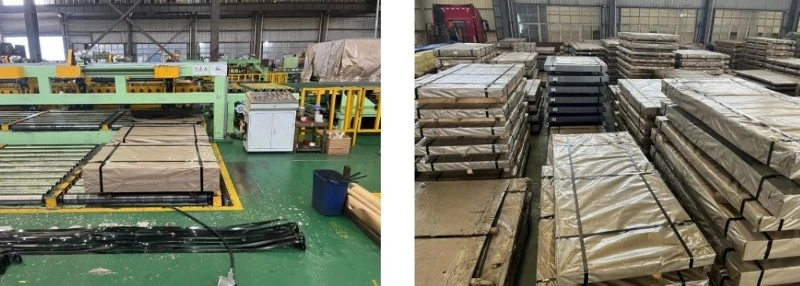
321 hot-rolled stainless steel plate can be used to manufacture boilers, heat exchangers, heating pipes, etc., and can operate stably in high temperature environments. It is suitable for equipment such as pipelines and chemical reactors in refineries and can resist corrosion from chemical media. For welded structures such as pressure vessels, 321 stainless steel can avoid sensitization in the heat-affected zone of welding and ensure the safety and reliability of the structure.
Here is the comparison of 321, 304, and 347 stainless steel grades :
| Grade | Key Difference | Typical Applications |
|---|---|---|
| 321 | Contains titanium (Ti) for superior high-temperature corrosion resistance and weldability, but higher cost. | High-temperature environments (e.g., boilers, heat exchangers) and applications requiring reliable welds. |
| 304 | No titanium addition, lower cost, excellent formability, but prone to sensitization at high temperatures. | Cost-sensitive applications in ambient conditions (e.g., food equipment, architectural decoration). |
| 347 | Stabilized with niobium (Nb) for slightly higher high-temperature strength than 321, but slightly lower corrosion resistance. | Specialized high-temperature scenarios requiring maximum strength (e.g., nuclear components, high-pressure vessels). |


