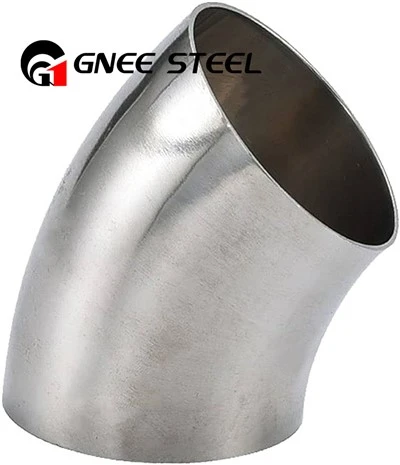
How to Deal with Cracks in Stainless Steel Elbows
Leave a message
Where Cracks Start in Austenitic Stainless Elbows
A stainless steel elbow changes flow direction and therefore concentrates stress at the intrados and extrados. Cracks rarely appear at random on the fitting body; they appear at the girth weld heat-affected zone, at the longitudinal seam of a welded elbow, at the inside radius where the wall has been thinned by forming, or at the toe of a butt weld where the pipe and fitting meet. Establishing which of those locations has failed is the first step, because the location points to the cause and the cause decides whether a repair is even permitted.
Dimensions of the fitting itself are defined by ASME B16.9 for wrought butt-welding fittings: a long radius 90 degree elbow has a centre-to-end dimension of 1.5 times the nominal pipe size, a short radius 90 degree elbow uses 1.0 times the nominal pipe size, and a long radius 45 degree elbow uses 0.625 times the nominal pipe size. Material requirements for wrought austenitic fittings come from ASTM A403/A403M with general requirements in ASTM A960/A960M. Checking the fitting against those dimensions is a fast way to confirm the elbow is the part that was ordered.
Root Causes of Cracking
| Mechanism | Typical location | Trigger |
|---|---|---|
| Chloride stress corrosion cracking | Weld toe, cold formed intrados | Wet chloride and metal temperature above about 60 °C |
| Sensitisation | Girth weld heat-affected zone | Exposure between 425 °C and 815 °C after welding |
| Cold work embrittlement | Formed intrados of tight radius | Excessive strain during forming, low residual ductility |
| Thermal fatigue | Weld toe and restraint points | Repeated thermal cycling with restrained expansion |
| Erosion-corrosion | Extrados, downstream of bends | High velocity wet steam or slurry, low pH |
Chloride stress corrosion cracking is the most common failure mode for 304 and 316 elbows in insulation, cooling water and coastal atmospheres. It is transgranular and often has almost no visible deformation, so a cracked elbow can look sound until it is examined. Sensitisation follows a different route: chromium carbides precipitate at grain boundaries and the adjacent chromium-depleted zone corrodes, giving an intergranular path that is detected by the tests of ASTM A262.
Detection and Assessment in the Field
Austenitic stainless steel is essentially non-magnetic, so magnetic particle examination is of little value on the fitting body. Use liquid penetrant examination to ASTM E165 to find surface-breaking cracks, then radiography or ultrasonic examination for through-wall and embedded defects. Wall thickness should be measured at the intrados and extrados, because forming reduces the wall on the inside radius and a thin intrados both raises stress and reduces the remaining ligament. Hardness readings in the heat-affected zone give a quick indication of whether the weld was heavily cold worked or left in an unfavourable condition.
Assessment should answer four questions: is the crack through wall or part wall, does it lie in the base metal or the heat-affected zone, is it single or branched, and is the material sensitised. A branched, transgranular crack network in a chloride environment is a stress corrosion crack, and a repair weld in the same location will usually crack again unless the environment or the stress is changed.
Repair or Replace
Replacement is the correct answer when the crack is through wall, when the crack is in the formed intrados where the wall is thinnest, when several cracks are present on the same fitting, or when the material is sensitised throughout the heat-affected zone. Repair welding can be considered for a short, isolated, part-wall crack in the base metal of a thick-wall fitting where the remaining section is adequate and where the service conditions that caused the crack can be corrected.
An acceptable repair sequence is: depressurise, drain and clean the fitting; excavate the crack fully by grinding to sound metal, checking with penetrant examination at each stage until no indication remains; qualify the welding procedure to ASME BPVC Section IX; weld with a matching austenitic filler using controlled heat input and an interpass temperature below about 150 °C; inspect the finished weld by penetrant examination and, where required, by radiography. Austenitic stainless weld repairs do not normally receive a post-weld heat treatment, but a component that had been sensitised may need a solution anneal, and any such treatment must be reviewed against the code of construction, whether that is ASME B31.3 for process piping or ASME B31.1 for power piping.
Preventing Repeat Failures
Three changes address most recurring elbow cracking. Remove chloride-bearing insulation or replace it with a low-chloride product, and keep the outside surface dry. Reduce restrained thermal movement by adding flexibility or a properly engineered expansion joint instead of forcing the line to absorb expansion through an elbow. Correct the process conditions that cause erosion-corrosion, either by lowering velocity or by changing the alloy to a duplex or higher-molybdenum grade. Where the environment cannot be changed, re-specify the fitting as a duplex or higher-alloy grade rather than replacing it in kind.
Frequently Asked Questions
Q: Can a cracked elbow be welded without being removed?
A: Only where the crack is isolated, part wall and in sound base metal, and where a qualified procedure and full access for grinding and inspection exist. Any crack in the heat-affected zone of a girth weld, or any crack found in the formed intrados, is normally a replacement item.
Q: Why did penetration examination miss the crack initially?
A: Penetrant finds surface-breaking defects only. A crack closed by compressive residual stress, or one that is fully embedded, will not be detected until it breaks the surface. Re-inspect after thermal cycling or use volumetric examination.
Q: Is 316 more resistant than 304 to this type of cracking?
A: Molybdenum improves resistance to pitting and to chloride attack in general, so 316 is better than 304 in chloride bearing service, but both austenitic grades remain susceptible to chloride stress corrosion cracking above roughly 60 °C. Duplex grades are a more effective change where temperature cannot be reduced.
Q: What wall thickness values should be expected on a stainless fitting?
A: Stainless pipe schedules follow ASME B36.19; for example the NPS 2 schedule 40S wall is 3.91 mm, NPS 4 schedule 40S is 6.02 mm and NPS 6 schedule 40S is 7.11 mm. Fittings to ASME B16.9 must have a wall thickness that satisfies the design pressure of the matching pipe.
Q: Does the fitting have to be re-marked after repair?
A: Yes. Traceability markings must be maintained or re-applied after any weld repair, and the repair should be recorded in the equipment history with the procedure reference, filler batch and inspection results.
Q: How often should installed elbows be inspected?
A: Base the interval on the failure mechanism. Chloride stress corrosion and thermal fatigue justify scheduled examination at a short interval; erosion-corrosion justifies wall thickness surveys at defined operating hour intervals.