


Q345R+316L Explosion-Bonded Stainless Clad Plate
Leave a message
If you are looking for a specialty metal solution that can withstand high-pressure loads and resist strongly corrosive media while significantly reducing material procurement costs for your project, Q345R+316L Explosion-Bonded Stainless Clad Plate is an exceptional option worth considering.
What is Q345R+316L Stainless Steel Clad Plate?
This composite material utilizes Q345R as the base layer to bear primary structural strength, pressure loads, and fabrication requirements, combined with 316L as the corrosion-resistant cladding layer. By leveraging the excellent corrosion resistance provided by 316L's chemical composition (approx. 16–18% Cr, 10–14% Ni, and 2–3% Mo), it is particularly suited for aggressive environments across chemical processing, petroleum, pharmaceuticals, storage tanks, pressure vessels, heat exchangers, and seawater treatment. Compared to solid 316L plates, the clad plate applies the 316L layer only on the side in direct contact with corrosive media, utilizing lower-cost Q345R for the remaining thickness. This approach significantly reduces high-alloy material consumption while meeting all design specifications, preserving the corrosion resistance and easy-to-clean surface properties of stainless steel.

As a leading global steel supplier, GNEE provides comprehensive supply and customization for Q345R+316L explosion-bonded stainless clad plates:
Dimensional Capabilities: Base layer (Q345R) thickness ranges from 6mm to 120mm, and cladding layer (316L) thickness ranges from 1.5mm to 10mm, with maximum widths reaching up to 3,800mm to meet seamless or reduced-weld assembly demands for large towers, reactors, and heat exchangers.
Standards & Quality Assurance: Products strictly comply with NB/T 47002.1 (Class I/II) and ASTM A264 / ASME SA-264 specifications. Every plate undergoes 100% Ultrasonic Testing (UT inspection up to Class 1/A level), tensile testing, and bend testing prior to dispatch, accompanied by third-party inspection reports from certified bodies such as SGS, BV, or TÜV.


If you are working on a specific design, please provide me with the following information:
the required thickness of the Q345R substrate and the 316L cladding, as well as the operating temperature and pressure of the vessel.
I can provide more targeted guidance on design standards or welding procedures.
Q345R + 316L Explosion-Bonded Clad Plate specification
| Item | Base Metal | Cladding Metal |
|---|---|---|
| Material Grade | Q345R – Boiler & Pressure Vessel Steel | 316L – Low-Carbon Austenitic Stainless Steel |
| Applicable Standard | GB/T 713 / Q345R | GB/T 3280 / ASTM A240 |
| Clad Plate Standard | NB/T 47002.1 – Pressure Vessel Clad Plate | ASTM A264 – Stainless Chromium-Nickel Steel-Clad Plate |
| Bonding Process | Explosion Bonding | Explosion Bonding |
| Bonding Type | Metallurgical Bonding | Metallurgical Bonding |
| Typical Application | Pressure vessels, storage tanks, reactors, boilers | Chemical, petrochemical, pharmaceutical and corrosion-resistant equipment |
Chemical Composition
| Material | C (%) | Si (%) | Mn (%) | P (%) | S (%) | Cr (%) | Ni (%) | Mo (%) |
|---|---|---|---|---|---|---|---|---|
| Q345R | ≤0.20 | 0.20–0.50 | 1.20–1.60 | ≤0.025 | ≤0.010 | - | - | - |
| 316L | ≤0.030 | ≤0.75 | ≤2.00 | ≤0.045 | ≤0.030 | 16.0–18.0 | 10.0–14.0 | 2.0–3.0 |
Note: Chemical composition values should be confirmed against the applicable material standard and purchase specification for the actual production batch.
Mechanical Properties
| Property | Typical / Required Value | Test Method |
|---|---|---|
| Tensile Strength (Rm) | ≥470 MPa* | ASTM A370 / GB/T 228.1 |
| Yield Strength (ReL / Rp0.2) | ≥345 MPa* | ASTM A370 / GB/T 228.1 |
| Elongation (A) | ≥20%* | ASTM A370 / GB/T 228.1 |
| Shear Strength of Bond | ≥210 MPa** | ASTM A264 / GB/T 6396 |
| Bend Test | 180°; no visible cracks in specified test area | ASTM A264 / GB/T 232 |
| Bond Integrity | Continuous metallurgical bond over the specified area | UT / Interface Inspection |
Typical Applications
Chemical reactors, storage tanks, and heat exchangers
Pressure vessels in petrochemical and pharmaceutical plants
Condensers, columns, and piping spools
Marine and desalination equipment


Inspection & Testing
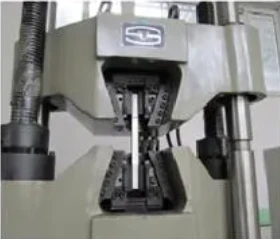
Each batch of products undergoes 100% Ultrasonic Testing (UT) to detect disbonding, lamination, and internal defects, alongside dimensional inspection for total thickness, cladding thickness, width, length, and flatness. Depending on project requirements, GNEE also provides tensile testing, 180° bend testing, bond/shear strength testing, chemical composition analysis, and Positive Material Identification (PMI) for the 316L cladding layer. For custom orders, we supply inspection records, Material Test Certificates (MTC / EN 10204 3.1 or 3.2), and third-party inspection services from agencies such as SGS or BV upon customer request, ensuring fully traceable quality data from raw materials to final shipment.

Standard export packaging
GNEE packages Q345R+316L explosion-bonded stainless clad plates according to dimensions, weight, transit distance, and client handling requirements to prevent deformation, impact damage, moisture exposure, and surface contamination during sea or land transportation.
Each plate is clearly stenciled with the heat number, material grade, dimensions, cladding orientation, and order details. When required, protective films or wrapping materials are applied to safeguard the 316L corrosion-resistant surface. Plates are securely stacked using separators on heavy-duty steel pallets or reinforced wooden skids, complete with corner protection to prevent handling damage. For export shipments, products are bound with steel strapping, wrapped with moisture-proof materials, and containerized according to loading specifications.


FAQ
Q: What are the advantages of explosion bonding compared to roll bonding?
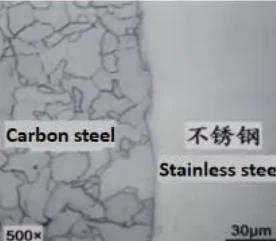
A: Explosion bonding belongs to the category of cold processing, forming a wavy metallurgical bond at the interface. Its advantages include: 1. Higher bond strength; 2. Ability to process thick plates with large total thickness (e.g., base metal >50mm); 3. Ability to join dissimilar metals with vast differences in physical properties.
Q: What is the required bonding rate for clad plates?
A: According to NB/T 47002.1 or ASTM A264 standards, clad plates for pressure vessels typically require 100% Ultrasonic Testing (UT). Class I plates require a bonding rate of ≥99%, while Class II plates require ≥98%. In certain critical areas (such as sealing surfaces or weld bevels), 100% bonding with no unbonded areas is usually required.
Q: What is the most critical factor to consider when welding Q345R+316L clad plates?
A: The most critical aspect is preventing carbon steel contamination of the stainless steel (carbon migration). The welding sequence is usually: Weld base metal (Q345R) → Back-gouge → Weld transition layer (typically using high Cr-Ni welding consumables such as E309L) → Finally weld cladding (316L, using E316L). Direct melting of the cladding layer with base metal electrodes is strictly prohibited.
Q: What is the role of the transition layer?
A: The transition layer buffers the difference in chemical composition between the base metal (ferritic) and the cladding layer (austenitic). Without a transition layer, carbon from the base metal would dilute the alloying elements of the cladding, causing the cladding weld to become brittle and lose its corrosion resistance.
Q: Is Post-Weld Heat Treatment (PWHT) required after welding clad plates?
A: If the thickness of the base metal Q345R reaches the standard requiring stress relief, heat treatment is necessary. However, caution must be exercised: heat treatment temperatures are typically between 580°C and 620°C. Prolonged dwell time in this range may cause carbide precipitation or σ-phase formation in 316L, affecting its corrosion resistance. Therefore, the heating rate and soak time must be precisely controlled.
Q: How much money can be saved by using clad plates compared to solid 316L stainless steel plates?
A: When the total thickness exceeds 12mm-15mm, the cost-effectiveness of clad plates becomes apparent. The thicker the plate, the more significant the cost savings. Material costs can typically be reduced by 30%-60%, while retaining the chemical properties of stainless steel and the structural strength of carbon steel.


