


Martensite Vs. Austenitic Stainless Steel - What Is The Difference?
Leave a message
Austenitic stainless steel and martensitic stainless steel are two important products in the stainless steel market. Today, we will use this blog post to explain the differences between the two products so that you can make an informed decision in your future projects!
austenitic vs martensitic crystal structure
Austenitic stainless steel:
Face-centered cubic (FCC) crystal structure. This structure is characterized by a relatively close and uniform arrangement of atoms in all directions, which makes austenitic stainless steel have good toughness and plasticity, and can withstand large deformation without breaking.
Martensitic stainless steel:
Body-centered tetragonal (BCT) crystal structure. The formation of martensite is usually achieved by heat treatment such as quenching, which rapidly cools austenite at high temperature and transforms austenite into martensite. The martensitic structure is relatively compact, but due to the asymmetry of its crystal structure, the hardness of martensitic stainless steel is relatively high, but the toughness is relatively low.
austenite vs martensite mechanical properties:
Strength:
The strength of martensitic stainless steel is relatively high, and the tensile strength can usually reach more than 1000MPa. The strength can be further improved after heat treatment. The strength of austenitic stainless steel is relatively low, generally between 500-800MPa.
Hardness:
The hardness of martensitic stainless steel is also higher than that of austenitic stainless steel, which can reach HRC50 or above. The hardness of austenitic stainless steel is lower, generally around HRC20.
martensitic vs austenitic toughness and plasticity:
Austenitic stainless steel has good toughness and plasticity, and can withstand large impacts and deformations without breaking. The toughness and plasticity of martensitic stainless steel are relatively poor, and it is easy to break when it is impacted or over-deformed.
martensitic vs austenitic application areas
Austenitic stainless steel is widely used in food processing, chemical industry, medical equipment, architectural decoration and other fields.
Martensitic stainless steel: Mainly used in tools, molds, valves, bearings and other fields with high requirements for hardness and strength.
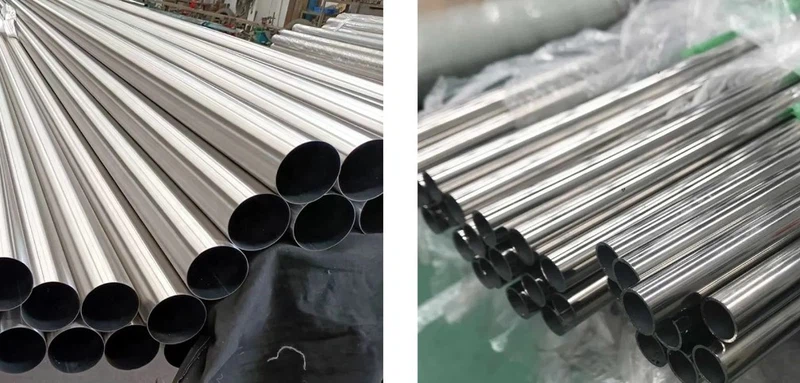
GNEE specializes in supplying austenitic and martensitic stainless steel plates, stainless steel pipes, stainless steel coils, stainless steel pipe fittings and other products. We have 16 years of export experience and export 10,000 tons of stainless steel products every year. Welcome to inquire!
Material Grades We Have
1) 300 Series: 301, 303, 304, 304L, 304LN, 304N, 309, 309S, 310, 310S, 316L, 316Ti, 317L, 321, 321H, 347H, 1.4319, 1.4305, 1.4301, 1.4306, 1.4833, 1.4845,
1. 4404, 1.4571, 1.4438, 1.4541, SUS304, SUS304L, SUS309S, SUS310S, SUS316, SUS316Ti, SUS316L, etc.
2) 400 series: 409, 409L, 410S, 420, 430, 440C, 444, 1.4016, 1.4006, 1.4002, 1.4125, 1.4501, 1.4362, 1.4460, 1.4521, 1.4545, 1.4547, etc.


