


A484 Standard Specification for Forgings.PDF
Leave a message
What Is the ASTM A484 Specification?
The ASTM A484 specification covers general requirements applicable to wrought stainless steel bars, shapes, forgings, and billets or other semi-finished materials intended for forging (excluding wire). These requirements apply to the latest revisions of the following ASTM specifications: A276, A314, A458, A473, A477, A479/A479M, A564/A564M, A565/A565M, A582/A582M, A638/A638M, A705/A705M, and A831/A831M.
Products supplied in accordance with ASTM A484 may be furnished in several conditions, which must be clearly specified in the purchase order: hot-worked; hot-worked and annealed; hot-worked, annealed, and cold-worked; or hot-worked, annealed, and heat-treated.
Austenitic and austenitic-ferritic (duplex) stainless steel grades shall be solution annealed, followed by suitable quenching and rapid cooling. Martensitic and precipitation-hardening stainless steel grades shall be supplied in the annealed or heat-treated condition, as specified by the applicable product standard.
Click to download ASTM A484 Forging Tolerances.pdf

ASTM A484 Dimensional Tolerances
| Product and condition | Typical tolerance basis |
|---|---|
| Hot-finished rounds, turned, and square bars | Diameter or distance-across-flats per A484 Table 1; turned bars normally available 50-625 mm diameter |
| Hot-finished hexagonal and octagonal bars | Distance across flats per A484 Table 2 |
| Hot-finished flat bars rolled as bars | Thickness and width per A484 Table 3 |
| Flat bars cut from strip or plate | Width and thickness per A484 Table 4 |
| Cold-finished round bars | Diameter per A484 Table 5, with tighter limits for precision ground stock |
| Cold-finished hex, octagon, and square bars | Distance across flats per A484 Table 6 |
| Straightness | Machine-straightened hot- or cold-finished bars per A484 Table 8, commonly 1/16 in per 4 ft for cold-finished rounds |
Out-of-round is measured as the difference between maximum and minimum diameter at the same cross-section; out-of-square is the difference between the two opposite-face dimensions of a square bar. Tolerances tighten with cold finishing, and precision-ground bar follows even tighter diameter limits.
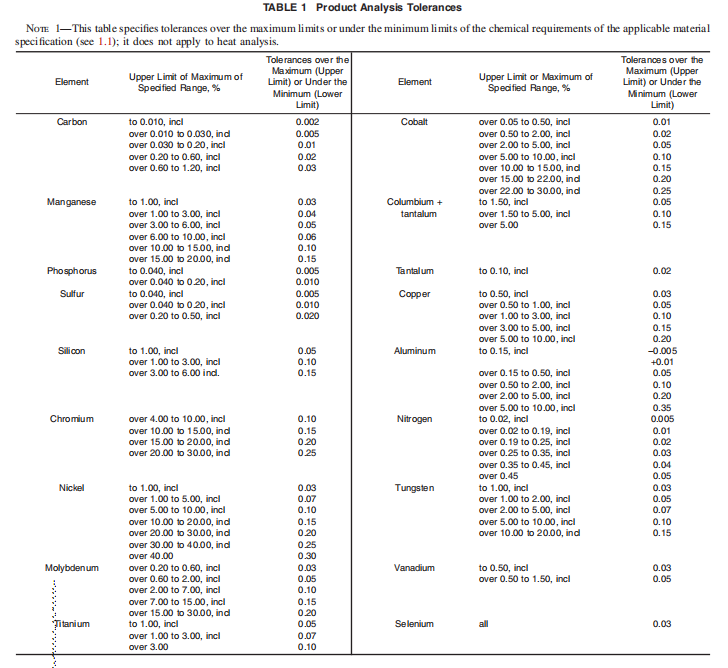
A484 Standard TABLE 1 Product Analysis Tolerances
A484 Standard TABLE 2 Annealing Requirements
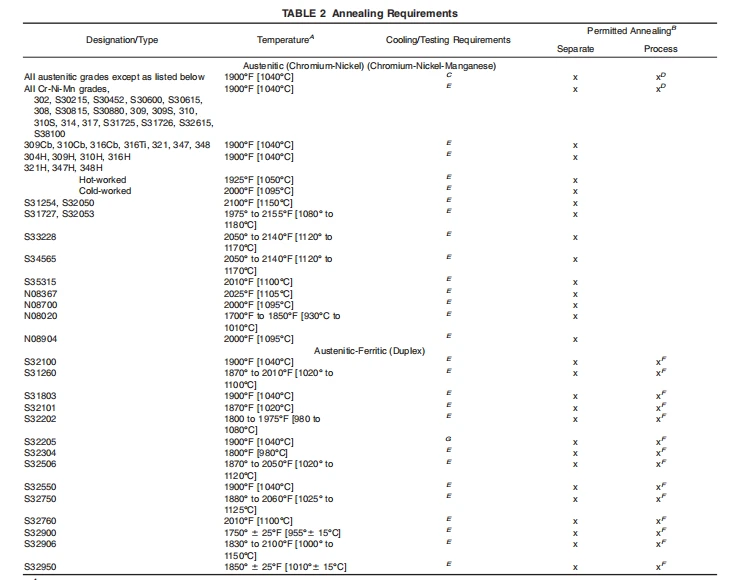
TABLE 3 Permitted Variations in Size of Hot-Finished RoundTured," and Square Bars
TABLE 4,5 Permitted Variations in Size of Hot-Finished Hexagonal and Octagonal Bar,Flat Bars

TABLE 6 Permitted Variations in Dimensions for Flat Bars Cut from Strip or Plate

TABLE7 Permitted Variations in Size of Cold-Finished Round Bars
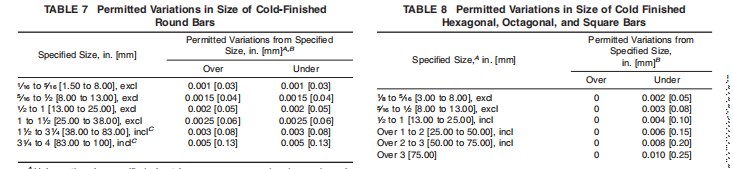
TABLE 9 Permitted Variations in Width and Thickness of Cold-Finished Flat Bars
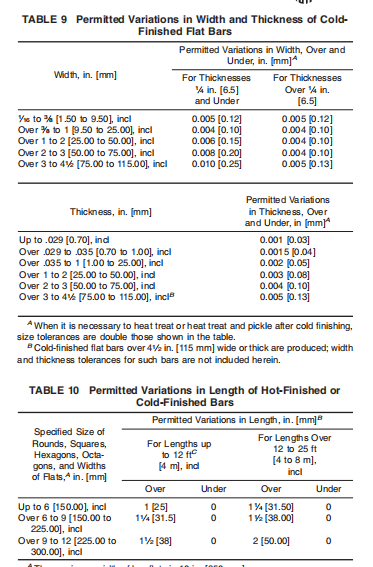
TABLE 14 Permitted Variations in Size of Hot-Finished Channels

TABLE 16 Permitted Variations in Size of Hot-Extruded Shapes

What are the differences between ASTM A484 and ASTM A479 or A182?
Standards such as A479 and A276 define the chemical composition, mechanical properties, and heat treatment requirements for specific grades, while deferring to A484 for dimensional tolerances, inspection rules, and general testing methods.
ASTM A182: This standard covers forgings for pressure piping systems. It typically references ASTM A961 for general requirements, rather than A484. Therefore, it is important to note that stainless steel forgings or bars intended for general mechanical applications usually follow A484, whereas forgings for flanges or valves used in pressure piping systems follow A961/A182.
When purchasing stainless steel forgings, which additional standards are typically required besides ASTM A484?
- ASTM A473: Standard Specification for Stainless Steel Forgings. This is the most directly applicable product standard for stainless steel forgings.
- ASTM A182 / A182M: Standard Specification for Forged or Rolled Alloy-Steel Pipe Flanges, Forged Fittings, Valves, and Parts for High-Temperature Service. Applicable when forgings are used in piping systems.
- ASTM A370: Standard Test Methods and Definitions for Mechanical Testing of Steel Products. Covers mechanical testing requirements for steel products.
- ASTM A388 / A388M: Standard Practice for Ultrasonic Examination of Steel Forgings. Commonly used for ultrasonic testing (UT) of heavy-section forgings to detect internal defects.


