


ASTM A312 TP310S High-Temperature Resistant Pipe for Cement Kilns
Leave a message
What is ASTM A312 TP310S high-temperature resistant pipe?
ASTM A312 TP310S seamless heat-resistant stainless steel pipe is a high-performance piping solution specifically engineered for the severe operating conditions of cement kilns. Engineered to sustain continuous operation at temperatures up to 1150°C, it is ideally suited for extreme thermal environments, including cement rotary kilns, calciners, preheaters, and tertiary air ducts.
Characterized by a high alloy content of 24–26% Chromium (Cr) and 19–22% Nickel (Ni), TP310S stainless steel forms a dense, self-healing passivating oxide film at elevated temperatures. This protective barrier effectively resists scale spalling and metal wastage induced by intense kiln flame radiation and hot gas erosion. The material exhibits an upper continuous service limit of 1150°C and a peak intermittent temperature capability of 1200°C. Furthermore, it demonstrates excellent resistance to thermal fatigue during cyclical heating and cooling phases during kiln startups and shutdowns, preventing premature wall thinning or catastrophic burn-through failure.
ASTM A312 TP310S Heat-Resistant Pipe Supplier
We supply ASTM A312 TP310S stainless steel round pipes. The solution-annealed and pickled (A&P) surface finish provides a smooth topography that minimizes clinker dust fouling, thereby reducing maintenance and cleaning frequencies. In contrast to conventional austenitic grades like 304, 316L, and 309S-which are highly susceptible to oxidation, scaling, and distortion under extreme temperatures and thermal cycling-TP310S retains a high elevated-temperature tensile strength (≥120 MPa at 1000°C). This high-temperature mechanical strength far surpasses lower-alloyed grades, ensuring the piping remains free from sagging, bulging, or permanent creep deformation over extended service life. In the high-temperature zones of the kiln, its service life is 2 to 3 times that of 304 or 309S piping. This significantly mitigates unscheduled downtime for piping maintenance and minimizes production losses resulting from kiln outages.
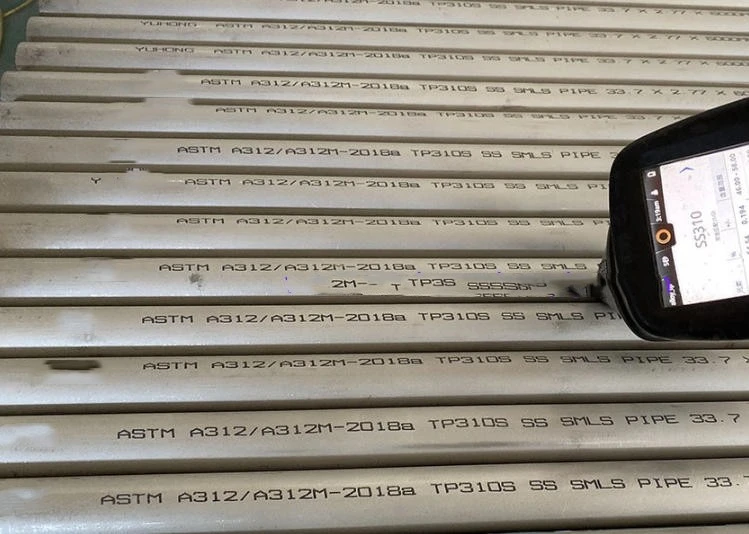

ASTM A312 TP310S Seamless Steel Pipe Specification
ASTM A312 TP310S Stainless Steel Seamless Pipe Chemical Composition
| Grade | C | Mn | Si | P | S | Cr | Ni |
| 310S | 0.08 | 2.00 | 1.50 | 0.045 | 0.030 | 24.0-26.0 | 19.0-22.0 |
ASTM A312 TP310S Seamless Pipe Mechanical Properties
| Grade | Tensile Strength (MPa) min | Yield Strength 0.2% Proof (MPa) min | Elongation (% in 50mm) min | Hardness | |
| Rockwell B (HR B) max | Brinell (HB) max | ||||
| TP310S | 515 | 205 | 40 | 95 | 217 |
ASTM A312 TP310S Stainless Steel Pipe Physical Properties
| Grade | Density (kg/m3) | Elastic Modulus (GPa) | Mean Coefficient of Thermal Expansion (m/m/0C) | Thermal Conductivity (W/m.K) | Specific Heat 0-1000C (J/kg.K) | Electrical Resistivity (n.m) | |||
| 0-100°C | 0-315°C | 0-538°C | at 100°C | at 500°C | |||||
| 310S | 7750 | 200 | 15.9 | 16.2 | 17.0 | 14.2 | 18.7 | 500 | 720 |
Tolerance for A312 Stainless Steel Seamless Tube Pipe
| Standard | Outside Diameter Tolerance(mm) | Thickness Tolerance | Length Tolerance (mm) | |||
| ASTM A312 | [10.29~48.26] | +0.4/-0.8 | 10.3~73 | +20% / -12.5% | +6/-0 | |
| 88.9~457 T/D≤5% | +22.5%/-12.5% | |||||
| (48.26~114.30] | ±0.80 | 88.9~457 T/D>5% | +15%/-12.5% | |||
| (114.30~219.08] | +1.6/-0.8 | 508above T/D<5% | +22.5%/-12.5% | |||
| (219.08~457.20] | +2.4/-0.8 | 508above T/D>5% | +15%/-12.5% | |||
What is the maximum continuous service temperature for TP310S?
Continuous service: Up to 1035°C (1900°F).
Intermittent service: Up to 1150°C (2100°F).
In cement kilns, it is frequently used for burner pipes, cooling pipes, and thermowells where temperatures fluctuate.
TP310S vs. 253MA (UNS S30815): High-Temperature Resistance
Due to its higher nickel content, TP310S performs better in reducing or sulfur-containing atmospheres. 253MA offers superior creep strength and oxidation resistance at temperatures up to 1150°C; it is often used as a high-performance alternative when piping is prone to sagging under its own weight at high temperatures.
Common Applications in Cement Plants
Calciners and Preheater Components: Piping and ductwork exposed to intense, cyclical thermal exhaust.
Gas Conditioning Towers: Systems spraying water to cool kiln exhaust gases, which creates high thermal and mildly acidic (sulfuric) corrosive conditions.
Burner Pipes and Lances: Parts extending directly into the primary combustion zone.
What makes TP310S suitable for cement kiln environments?
Cement kilns operate at extreme temperatures, often between 900°C and 1150°C. TP310S (UNS S31008) is an austenitic stainless steel that provides excellent oxidation resistance and high creep strength. Its high Nickel and Chromium content forms a stable protective oxide layer, preventing the pipe from scaling or thinning rapidly in the kiln's hot gas zones.
Quality Control
| Test Category | Inspection Item |
| Chemical Analysis | Full Element Check + PMI |
| Mechanical Test | Tensile & Yield Testing |
| Microstructure | Grain Size Analysis (ASTM E112) |
| Non-Destructive | Hydrostatic or Eddy Current |
| NDT (Optional) | Ultrasonic Testing (UT) |
| Corrosion Test | Intergranular Corrosion (IGC) |
| Dimensions | Straightness & Ovality |


Packaging Specifications
ASTM A312 TP310S steel pipes are bundled using heavy-duty galvanized steel straps, with protective rubber cushioning pads inserted at contact points to prevent surface abrasion. Pipe ends are sealed with reinforced vinyl or PE caps to ensure internal cleanliness. Export shipments are packed in IPPC-certified fumigated solid wood or plywood crates, lined with a waterproof layer (such as asphalt paper or PE film) and secured with high-density V-shaped foam supports to prevent damage from bending or impact. Each bundle bears a stamped stainless steel tag indicating the heat number, specifications, and steel grade, ensuring 100% traceability on-site.

FAQ
Which filler metal should be used when welding A312 TP310S?
To match the heat resistance of the base metal, ER310 (for TIG/MIG welding) or E310 (for manual arc welding) filler materials should be used. It is crucial to maintain low heat input to prevent hot cracking, a common risk associated with fully austenitic steels.
Should seamless or welded TP310S pipe be selected for kiln applications?
For cement kilns, seamless (SMLS) pipe is strongly recommended. Seamless pipe lacks weld seams, which often serve as "weak points" prone to localized oxidation and thermal fatigue. Seamless pipe offers superior structural reliability under the extreme thermal cycling conditions found in kilns.
Which filler metal should be used when welding A312 TP310S?
To match the heat resistance of the base metal, ER310 (for TIG/MIG welding) or E310 (for manual arc welding) filler materials should be used. It is crucial to maintain low heat input to prevent hot cracking, a common risk associated with fully austenitic steels.


