


ASTM A632 Austenitic Small-Diameter Tubing
Leave a message
What is ASTM A632 austenitic small-diameter tubing?
ASTM A632 covers seamless and welded austenitic stainless steel tubing designed for small-diameter applications requiring corrosion resistance and reliable performance in low- and high-temperature service. It covers outside diameters from 0.050 in. to under 0.500 in. (1.27–12.7 mm) and wall thicknesses from 0.005 in. to under 0.065 in. (0.13–1.65 mm). Common grades include TP304, TP304L, TP310, TP316, TP316L, TP317, TP321, TP347, and TP348. Tubing is typically supplied cold-finished and heat-treated by solution annealing at a minimum of 1,800°F (980°C), followed by water quenching or rapid cooling.
Click to download ASTM A632.pdf

1. ASTM A632 Scope & Size Range
|
Parameter |
Technical Specification / Standard Limit |
|---|---|
|
Applicable Size Range (OD) |
Up to and including 0.500 in. (12.7 mm) |
|
Applicable Size Range (WT) |
0.0015–0.065 in. (0.038–1.65 mm) |
|
Manufacturing Process |
Seamless (SML) or Welded (WLD), cold-finished |
|
Standard Delivery Condition |
Solution Annealed and Pickled / Bright Annealed (Vacuum or Hydrogen) |
|
Optional Hardness Tempers |
Cold-worked conditions, including 1/8 Hard, 1/4 Hard, Half Hard, and Full Hard, upon agreement |
|
Surface Finish |
Mill Finish, Passivated, or Commercially Mechanically / Chemically Polished |
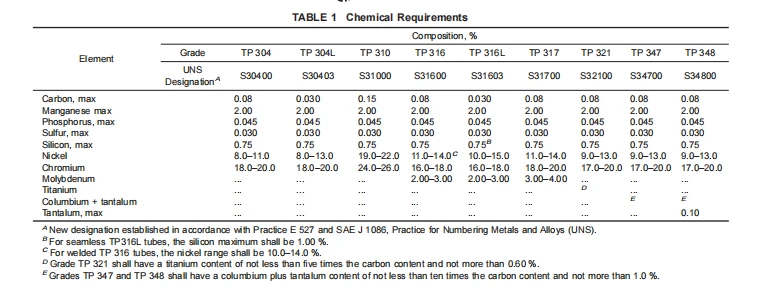
2.ASTM A632 Small-Diameter Tubing Chemical Composition wt %
3. Mechanical Property Requirements (Annealed Condition)
Mechanical properties are measured at ambient temperature (20°C ± 5°C).
|
Grade |
Tensile Strength, min. [ksi (MPa)] |
Yield Strength, min. (0.2% Offset) [ksi (MPa)] |
Elongation in 2 in. (50 mm), min. (%) |
Typical Hardness, max. (HRB / HV) |
|---|---|---|---|---|
|
TP304 |
75 (515) |
30 (205) |
35 |
90 HRB / 192 HV |
|
TP304L |
70 (485) |
25 (170) |
35 |
90 HRB / 192 HV |
|
TP316 |
75 (515) |
30 (205) |
35 |
90 HRB / 192 HV |
|
TP316L |
70 (485) |
25 (170) |
35 |
90 HRB / 192 HV |
|
TP321 |
75 (515) |
30 (205) |
35 |
90 HRB / 192 HV |
|
TP347 |
75 (515) |
30 (205) |
35 |
90 HRB / 192 HV |
Note a: For tubing with an outside diameter (OD) smaller than 0.187 in. (4.76 mm) or a nominal wall thickness below 0.015 in. (0.38 mm), elongation values may decrease significantly due to specimen geometry. Consult the manufacturer for applicable reduced gauge length values.
4.Dimensional Tolerances (Permissible Variations)
Dimensional tolerances are particularly important for ASTM A632 tubing due to its small outside diameters and thin wall thicknesses.
A. Outside Diameter (OD) and Wall Thickness (WT) Tolerances
|
Specified Outside Diameter Range, in. (mm) |
Tolerance on Specified OD, in. (mm) |
Tolerance on Specified WT |
|---|---|---|
|
Up to 0.093 (2.38), excl. |
+0.002 / -0.000 (+0.05 / -0.00) |
±10% |
|
0.093 to 0.187 (2.38 to 4.76), excl. |
+0.003 / -0.000 (+0.08 / -0.00) |
±10% |
|
0.187 to 0.500 (4.76 to 12.70), incl. |
+0.004 / -0.000 (+0.10 / -0.00) |
±10% |
Note: For thin-wall tubing with a nominal wall thickness less than or equal to 3% of the outside diameter, the permitted ovality may allow the OD variation to reach twice the tabulated tolerance, provided that the average OD remains within the specified tolerance.
B. Length Tolerances (Cut Lengths)
|
Specified Length, ft (m) |
Permissible Positive Variation, in. (mm) |
Negative Tolerance |
|---|---|---|
|
Up to 10 ft (less than 3 m) |
+1/8 (+3.2) |
0 |
|
10 to 24 ft (3 to 7.3 m) |
+3/16 (+4.8) |
0 |
|
Over 24 ft (over 7.3 m) |
+1/4 (+6.4), or as agreed in the contract |
0 |
5. ASTM A632 Small-Diameter Tubing Testing Requirements
|
Test Category |
Standard / Test Method |
Frequency / Scope |
Acceptance Criteria |
|---|---|---|---|
|
Tension Test |
ASTM A370 / ASTM E8 |
1 test per lot of 250 tubes or fraction thereof |
Meets specified mechanical property requirements |
|
Flaring Test |
ASTM A1016 |
1 test per lot on annealed tubes |
No visible cracking when flared over a 60° expander |
|
Hydrostatic Test |
ASTM A1016 |
100% of finished tubes, unless replaced by an approved NDT method |
Meets the specified hydrostatic pressure requirements |
|
Nondestructive Eddy Current Testing |
ASTM E426 |
100% testing when substituted for hydrostatic testing, where permitted |
Signal response remains below the established calibration threshold |
|
Air-Under-Water Test (Optional) |
Supplementary Requirement |
100% submerged air test, typically at 100–150 psi |
No visible bubble leakage |
|
Intergranular Corrosion Test |
ASTM A262, Practice E |
Supplementary Requirement S1 |
No fissures or cracking during the specified bend test |
|
Surface Roughness Inspection |
Profilometer Measurement |
As agreed, e.g., Ra ≤ 0.4 μm (15 μin.) for MP/EP grades |
Meets the purchaser's specified surface finish requirements |
What is the main difference between ASTM A632 and ASTM A269 stainless steel tubing?
- Size Range: ASTM A269 covers general-purpose stainless steel tubing in a broad range of sizes, typically including tubing with an OD of 1/4 inch and above. ASTM A632 specifically covers small-diameter stainless steel tubing with an OD below 0.500 in. (12.7 mm), including miniature and capillary tubing.
- Tolerances and Testing: Due to its smaller diameters and thinner walls, ASTM A632 places particular emphasis on dimensional accuracy and tighter control of OD and wall thickness. It also includes testing and inspection requirements suited to small-size tubing, including mechanical testing and applicable nondestructive examination methods.
What are the common delivery conditions and surface finishes for ASTM A632 small-diameter stainless steel tubing?
Heat Treatment: Tubing is typically solution annealed after the final cold-drawing or cold-rolling process to relieve residual stresses and restore corrosion resistance.
Surface Finish: Bright Annealed (BA) is a common delivery finish, providing smooth and clean internal and external surfaces. For demanding applications, such as semiconductor and medical equipment, additional internal mechanical polishing or electropolishing (EP) can be specified.
What are the main applications of ASTM A632 small-diameter stainless steel tubing?
Due to its small outside diameter, thin wall thickness, and dimensional precision, ASTM A632 stainless steel tubing is widely used in the following industries:
Medical and Biotechnology: Medical needles, Veress needles, trocars, cannulas, and minimally invasive surgical instruments.
Instrumentation and Analytical Chemistry: Capillary tubing for gas chromatography (GC) and high-performance liquid chromatography (HPLC), as well as pressure sensor impulse lines.
Industrial and Aerospace Control Systems: Miniature hydraulic lines, thermocouple protection tubes, and fuel injection fluid delivery lines.


