


Overview of Stainless Steel Sheet Surface Finishes
Leave a message
Why Does Stainless Steel Sheet Surface Finish Matter?
If you are sourcing stainless steel sheets for architectural projects, food processing equipment, industrial machinery, or chemical processing applications, choosing the correct surface finish is just as important as selecting the right stainless steel grade.Stainless steel sheet surface finish affects more than appearance. It directly influences corrosion resistance, cleanability, reflectivity, scratch visibility, fabrication requirements, maintenance costs, and overall product performance.
Different finishes are produced through processes such as hot rolling, cold rolling, annealing, pickling, mechanical polishing, brushing, and buffing. For example, a 2B finish provides a smooth, moderately reflective surface suitable for general industrial applications, while a BA finish offers higher reflectivity for decorative and precision applications. A No. 1 finish, by comparison, has a rougher, non-reflective appearance and is commonly used in industrial equipment.
What Is Stainless Steel Sheet Surface Finish?
Stainless steel sheet surface finish refers to the surface condition and texture obtained through specific manufacturing and finishing processes. It describes characteristics such as roughness, gloss, reflectivity, uniformity, and surface appearance.
According to common stainless steel product specifications, including ASTM A480/A480M and EN 10088-2, surface conditions are identified by designations such as No. 1, 2D, 2B, BA, No. 4, and No. 8.
These finishes generally fall into three categories:
Mill finishes: Produced during hot rolling or cold rolling, such as No. 1, 2D, and 2B.
Bright and reflective finishes: Produced through controlled annealing or mechanical polishing, such as BA and No. 8.
Decorative and textured finishes: Produced through abrasive finishing or surface treatment, such as No. 3, No. 4, HL, and embossed finishes.
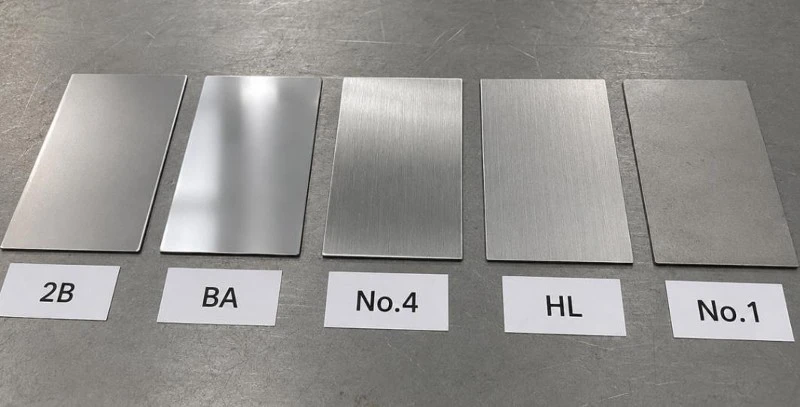
One important purchasing consideration is that surface finish and stainless steel grade are two different specifications. For example, 304 2B and 316L 2B have similar surface appearances but different chemical compositions and corrosion resistance.
Main Types of Stainless Steel Sheet Surface Finishes
Stainless steel sheets are available in several standard and customized surface finishes. The most commonly specified options include No. 1, 2D, 2B, BA, No. 4, HL, and No. 8.Each finish has different manufacturing characteristics, surface appearance, and application requirements.
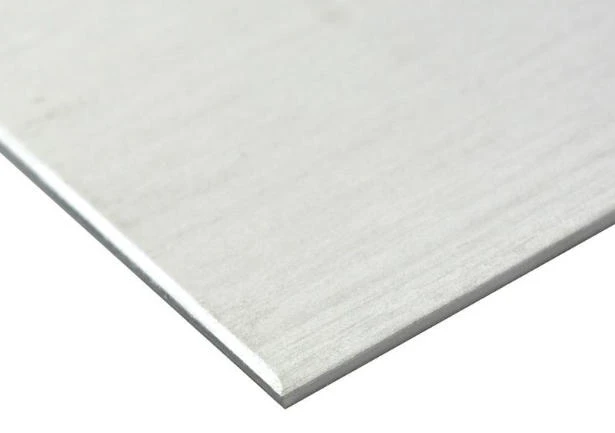
Stainless Steel No. 1 Finish (Hot-Rolled Finish)
No. 1 finish is produced by hot rolling stainless steel to the required thickness, followed by annealing and pickling or descaling to remove surface scale. It has a relatively rough, dull, and non-reflective appearance.
Typical characteristics:
Manufacturing process: Hot rolling + annealing + pickling.
Appearance: Rough, dull, and non-reflective.
Surface texture: Relatively coarse and irregular.
Common grades: 304, 304L, 316L, 321, 310S, and duplex 2205.
Main applications: Industrial tanks, pressure vessels, chemical equipment, and heavy machinery.
Stainless Steel 2D Finish (Cold-Rolled Dull Finish)
2D finish is produced through cold rolling, heat treatment, and pickling. Unlike 2B, it does not receive the same final skin-pass treatment using polished rolls. The resulting surface is smooth but has a dull, matte appearance with relatively low reflectivity.
Typical characteristics:
Manufacturing process: Cold rolling + annealing + pickling.
Appearance: Smooth, matte, and non-reflective.
Surface texture: More uniform than No. 1.
Common grades: 304, 304L, 316, and 316L.
Main applications: Deep-drawn components, industrial equipment, and fabricated parts.
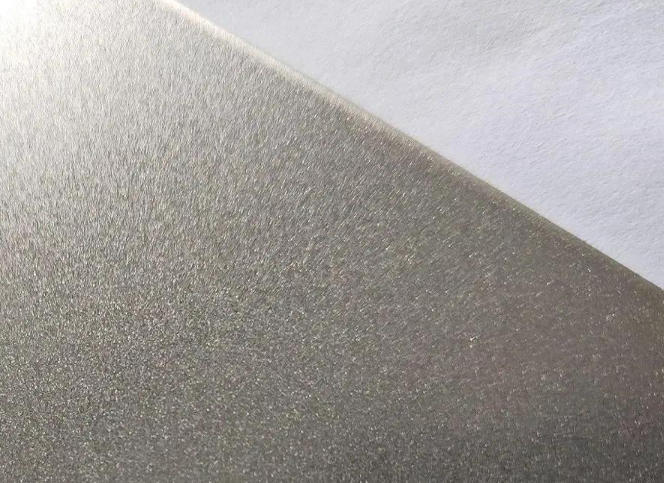
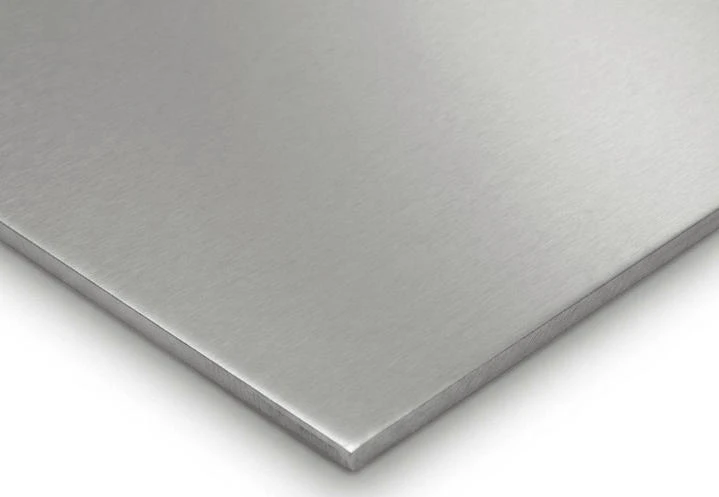
Stainless Steel 2B Finish (General-Purpose Cold-Rolled Finish)
2B is one of the most widely used stainless steel sheet finishes in industrial and commercial applications. It is produced by cold rolling, annealing, pickling, and a final light rolling pass using polished rolls.
Typical characteristics:
- Manufacturing process: Cold rolling + annealing + pickling + skin passing.
- Appearance: Smooth, slightly reflective, and uniform.
- Surface roughness: Typically Ra 0.30–0.50 μm as a general reference, not a universal acceptance limit.
- Common grades: 201, 304, 304L, 316, 316L, and 430.
- Main applications: Kitchen equipment, food processing machinery, industrial enclosures, storage tanks, and general fabrication.
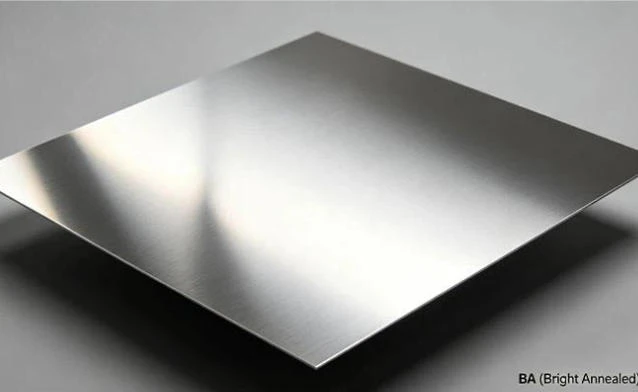
Stainless Steel BA Finish (Bright Annealed Finish)
BA finish is produced by cold rolling followed by bright annealing in a controlled protective atmosphere. This process prevents surface oxidation and scale formation during heat treatment, eliminating the need for conventional pickling to remove annealing scale.
Typical characteristics:
- Manufacturing process: Cold rolling + bright annealing.
- Appearance: Bright, smooth, and reflective.
- Surface texture: Fine and uniform.
- Common grades: 304, 304L, 316L, and 430.
- Main applications: Home appliances, kitchen equipment, automotive components, decorative panels, and precision equipment.
Stainless Steel No. 4 Finish (Brushed Finish)
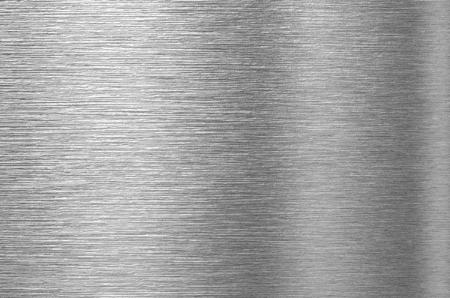
No. 4 finish is a mechanically polished surface produced using abrasive belts or other grinding materials. It features fine, directional polishing lines that create a satin-like appearance.
Typical characteristics:
- Manufacturing process: Mechanical grinding + abrasive polishing.
- Appearance: Brushed, satin-like, and directional.
- Surface texture: Fine linear grain.
- Common grades: 304, 304L, 316, and 316L.
- Main applications: Elevator panels, kitchen appliances, architectural decoration, commercial interiors, and equipment covers.
Stainless Steel No. 8 Finish (Mirror Finish)
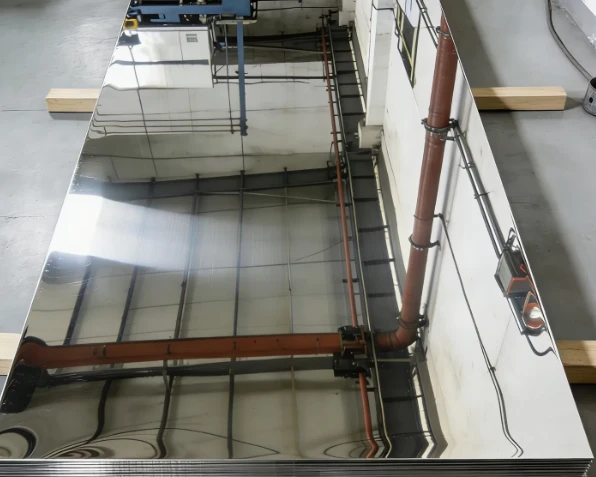
No. 8 finish is a highly reflective mechanical polishing finish produced through multiple stages of progressively finer abrasive polishing and final buffing. It creates a mirror-like surface with high image clarity.
Typical characteristics:
- Manufacturing process: Multi-stage mechanical polishing + fine buffing.
- Appearance: Highly reflective, mirror-like surface.
- Surface texture: Very smooth, with high image clarity.
- Common grades: 304, 304L, and 316L.
- Main applications: Luxury architectural decoration, elevator interiors, display equipment, decorative panels, and premium kitchen equipment.
304 316 Stainless Steel Sheet Surface Finish Comparison Table
The following table summarizes the most common stainless steel sheet finishes to help procurement teams compare manufacturing processes, appearances, and applications.
|
Surface Finish |
Manufacturing Process |
Appearance |
Typical Applications |
|---|---|---|---|
|
No. 1 |
Hot rolling, annealing, pickling |
Rough, dull |
Pressure vessels, tanks |
|
2D |
Cold rolling, annealing, pickling |
Smooth, matte |
Industrial components |
|
2B |
Cold rolling, annealing, pickling, skin passing |
Smooth, slightly reflective |
General fabrication |
|
BA |
Cold rolling, bright annealing |
Bright, reflective |
Appliances, precision parts |
|
No. 4 |
Mechanical abrasive polishing |
Satin, brushed |
Kitchen equipment, decoration |
|
HL |
Continuous mechanical brushing |
Long hairline grain |
Elevators, architecture |
|
No. 8 |
Fine mechanical polishing and buffing |
Mirror-like |
Premium decoration |
|
Embossed |
Pattern rolling or embossing |
Textured, patterned |
Flooring, wall panels |
ASTM A480 vs. EN 10088-2: Stainless Steel Surface Finish Standards
When purchasing stainless steel sheets for international projects, buyers may encounter different surface finish designation systems. ASTM A480/A480M is commonly used for stainless steel flat products in North American specifications, while EN 10088-2 specifies technical delivery conditions and surface finish designations for European stainless steel flat products.
Although some finish codes are similar, buyers should not assume that every designation is completely identical in manufacturing requirements or surface characteristics.
|
Surface Description |
ASTM A480/A480M |
EN 10088-2 |
|---|---|---|
|
Hot-rolled, annealed and pickled |
No. 1 |
1D |
|
Cold-rolled, dull |
No. 2D |
2D |
|
Cold-rolled, smooth |
No. 2B |
2B |
|
Bright annealed |
BA |
2R |
|
Ground finish |
No. 3 (general comparison) |
2G |
|
Brushed finish |
No. 4 |
2J |
|
Satin finish |
No. 6 |
2K |
|
Mirror finish |
No. 8 |
2P |
How to Choose the Right Stainless Steel Sheet Surface Finish?
Selecting the correct surface finish requires considering the application environment, required appearance, cleaning requirements, fabrication method, and purchasing budget.
The following recommendations can help buyers narrow down their options.
|
Application |
Recommended Finish |
Main Reason |
|---|---|---|
|
Chemical storage tanks |
No. 1 / 2B |
Industrial surface requirements |
|
Food processing equipment |
2B / BA / No. 4 |
Easier cleaning and maintenance when properly specified |
|
Kitchen equipment |
2B / BA / No. 4 |
Smooth surface and attractive appearance |
|
Elevator doors |
No. 4 / HL / No. 8 |
Decorative appearance |
|
Architectural wall panels |
HL / No. 4 / No. 8 |
Consistent surface appearance |
|
Automotive components |
BA / 2B |
Smooth surface and forming requirements |
|
Pressure vessels |
No. 1 / 2B |
Suitable for industrial fabrication |
|
Flooring and stair treads |
Embossed |
Textured surface and grip |
FAQ
Q1. What is the most common surface finish for stainless steel sheets?
2B is one of the most widely used stainless steel sheet finishes. It offers a smooth, slightly reflective surface and is suitable for general industrial fabrication, kitchen equipment, storage tanks, and machinery components. It can also serve as a base for further brushing and polishing.
Q2. What is the difference between 2B and BA stainless steel sheets?
The main difference is the final surface treatment.
2B is produced through cold rolling, annealing, pickling, and skin passing, while BA is produced through cold rolling and bright annealing in a controlled protective atmosphere.
BA generally has a brighter, more reflective, and smoother surface than 2B. It is commonly used in decorative panels, appliances, and precision components.
Q3. Is No. 4 stainless steel the same as brushed stainless steel?
No. 4 is a commonly specified brushed or satin-like finish produced through mechanical abrasive polishing. However, not all brushed finishes are identical to No. 4.
Q4. Which stainless steel finish is best for food processing equipment?
2B and BA are commonly used for food processing equipment, while No. 4 and other mechanically polished finishes may be selected for specific hygienic or decorative requirements.The correct selection depends on the cleaning procedure, product contact conditions, required surface roughness, and applicable hygiene standards. A specified Ra value and appropriate inspection are more reliable than relying on the finish designation alone.


