


What is a UNS S32750 plate for a bottom cone?
Leave a message
What is a UNS S32750 plate for bottom cone?
A UNS S32750 plate for a bottom cone refers to a conical section of a pressure vessel, tank, or hopper fabricated from Super Duplex 2507 stainless steel plate. This component is specifically engineered for applications requiring exceptional resistance to chloride stress corrosion cracking, high pressure, and abrasive slurries, commonly found in the bottom sections of separators, reactors, and desalination vessels.

Could you please provide more details so that I can better assist you? What plate thickness do you require? What specific chemicals will the cone come into contact with, or what are the operating temperature conditions? I can help estimate material requirements or provide more specific manufacturing steps.
ASTM A240 UNS S32750 plate supplier
GNEE Stainless Steel supplies ASTM A240 / ASME SA-240 UNS S32750 hot-rolled plates. All slabs undergo high-temperature solution annealing (1050–1100°C) followed by rapid water quenching to ensure a stable ferrite-to-austenite ratio of approximately 50:50, preventing toughness loss caused by intermetallic phase precipitation. With a PREN (Pitting Resistance Equivalent Number) ≥ 40, these plates offer significantly superior resistance to pitting and crevice corrosion compared to standard 316L and conventional duplex stainless steels, particularly in environments containing chloride ions, acidic media, or high humidity.
In the solution-annealed state, UNS S32750 duplex stainless steel plates exhibit a yield strength of ≥550 MPa and a tensile strength of 795–1000 MPa-approximately double that of austenitic stainless steel. This high strength allows for reduced bottom-cone wall thickness, lower equipment weight, and decreased welding consumable costs. The material also offers excellent resistance to stress corrosion cracking (SCC), capable of withstanding the combined effects of concentrated stress and corrosive media at the bottom cone.
GNEE supplies UNS S32750 plates with thicknesses ranging from 3 mm to 120 mm, widths up to 3500 mm, and lengths up to 12,000 mm. We offer customized conical blanks, sector plates, and extra-large heavy plates, supporting plasma cutting, edge beveling, and pre-forming blank preparation based on customer drawings, with edge flatness maintained at ≤1.5 mm/m.


ASTM A240 UNS S32750 stainless steel plates specification
| Item | Specification |
|---|---|
| Product | Super Duplex Stainless Steel Plate for Bottom Cone |
| Material Grade | UNS S32750 / ASTM A240 S32750 |
| EN Grade | 1.4410 (X2CrNiMoN25-7-4) |
| Standard | ASTM A240 / ASME SA240 / EN 10088 |
| Manufacturing Process | Hot Rolled (HR) / Cold Rolled (CR) |
| Plate Thickness | 3.0–100 mm |
| Width | 1000–3000 mm |
| Length | 2000–12000 mm |
| Shape | Flat Plate / Cut-to-Size Plate / Bottom Cone Plate |
| Forming Service | Rolling, Press Forming, Cone Forming, Beveling |
| Surface Finish | No.1, 2B, Pickled, Polished |
| Edge | Mill Edge (ME) / Slit Edge (SE) |
| Heat Treatment | Solution Annealed & Water Quenched |
| Certification | EN 10204 3.1 / 3.2, PMI, MTC |
| Inspection | UT, PMI, Dye Penetrant (PT), Dimensions Inspection |
| Packing | Wooden Pallets, Export Wooden Cases, Waterproof Package |
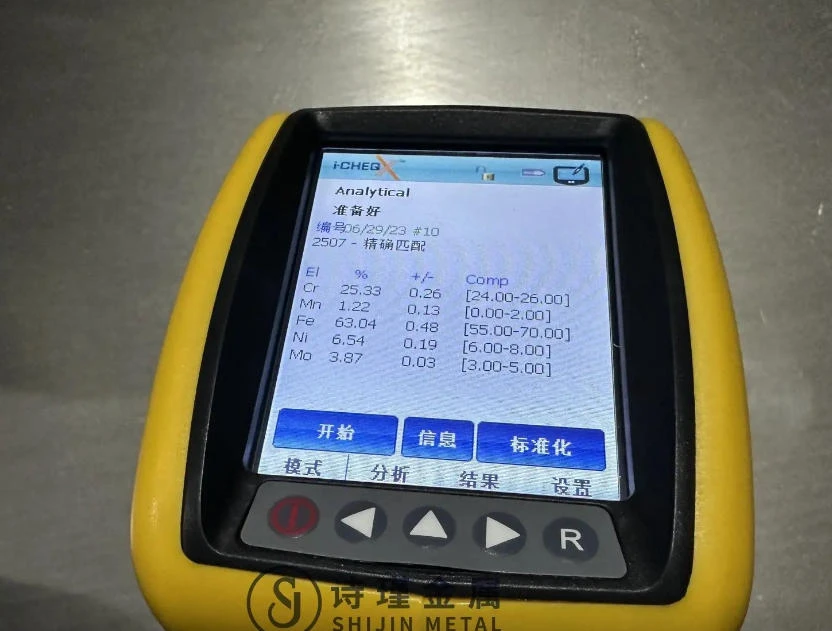
Chemical composition
| Scope | C | Si | Mn | P | S | Cr | Ni | Mo | Cu | N | W | PREN | Fe |
|---|---|---|---|---|---|---|---|---|---|---|---|---|---|
| Min | • | • | • | • | • | 24.00 | 6.00 | 3.00 | 0.50 | 0.20 | 0.50 | 40.00 | 0.00 |
| Max | 0.03 | 1.00 | 1.00 | 0.030 | 0.010 | 26.00 | 8.00 | 4.00 | 1.00 | 0.30 | 1.00 | • | 0.00 |
(PREN = % Cr + 3.3% Mo + 16% N)
Mechanical Properties (at Room Temperature)
| Tensile Strength (Rₘ) | ≥ 795 MPa (116 ksi) |
| Yield Strength (Rₚ₀.₂) | ≥ 550 MPa (80 ksi) |
| Elongation (A₅₀ₘₘ) | ≥ 15 % |
| Hardness (Max) | ≤ 310 HBW / ≤ 32 HRC |
| Charpy V-Notch Impact Test | ≥ 50 J at -46°C (-50°F) (Average of 3 specimens) |
What is the difference between 2507 and 2205 stainless steel?
The Pitting Resistance Equivalent Number (PREN) of 2507 is typically greater than 42, whereas that of 2205 is approximately 35. While 2205 is commonly used in general chemical processing, papermaking, and food processing equipment, 2507 is frequently employed in marine engineering, deep-sea oil and gas pipelines, seawater desalination plants, and highly acidic chemical environments.
What should be considered when processing and welding 2507?
Forming: Due to its high strength, 2507 requires greater force for cold forming compared to standard stainless steels.
Welding: 2507 has good weldability, but heat input must be strictly controlled.
It is recommended to use matching filler materials or those with slightly higher alloy content (such as 25.10.4.L).
What are the temperature limits for 2507 stainless steel?
Long-term use above 315°C (600°F) is generally not recommended because prolonged exposure to this temperature range can cause "475°C embrittlement," making the material brittle. Although it performs better than standard ferritic steels, its impact toughness drops significantly at extremely low temperatures (e.g., below -50°C); therefore, low-temperature impact testing is required in accordance with specific pressure vessel standards.
Super Duplex S32750 Plate Applications
Offshore platforms, heat exchangers, process and service water systems, fire-fighting systems, injection and ballast water systems
Chemical process industries, heat exchangers, vessels, and piping
Desalination plants, high pressure RO-plant and seawater piping
Mechanical and structural components, high strength, corrosion-resistant parts
Power industry FGD systems, utility and industrial scrubber systems, absorber towers, ducting, and piping

UNS S32750 Super Duplex Plate price per kg
The price of UNS S32750 super duplex stainless steel plate typically ranges from $8.50 to $12.00 per kilogram (or approximately $3,900 to $5,500 per metric ton). However, actual pricing varies based on order volume, plate thickness, and fluctuations in global nickel and molybdenum surcharges. Costs may be higher-potentially exceeding $15.00 per kilogram-for small-batch cut-to-size pieces, thin sheets, or special surface finishes.
To obtain an accurate quote for your project, please provide the following details: the required thickness and dimensions; the estimated order volume (in kilograms or pounds); and whether you require custom cutting, profile processing, or specific testing (such as NACE compliance).
Quality Control
Each batch of products comes with an original Mill Test Certificate (MTC). Third-party reports for spectral PMI analysis, ultrasonic testing (UT), and intergranular corrosion testing are available upon request. We hold ISO 9001, PED, and SGS certifications. Backed by readily available stock, the lead time for standard specifications is 7–12 working days.


Standard packaging
Packaging: Each sheet or coil is wrapped in moisture-proof paper with a plastic film lining and secured with steel strapping. The exterior is protected by wooden pallets or wooden crates to ensure safety during international transport.
Labeling: Each package is marked with the heat number, grade, dimensions, and standard specifications.
Shipping Method: Sea freight (FCL/LCL), air freight, or express delivery, depending on customer requirements.


