What is the equivalent material for inox 304?
Leave a message
If you're sourcing Inox 304 stainless steel for international projects or comparing materials across standards, it's essential to understand its global equivalent materials. Inox 304, also known as AISI 304, is one of the most commonly used austenitic stainless steels, known for its excellent corrosion resistance, weldability, and versatility.
In this article, we'll help you quickly identify international equivalents of Inox 304 and explain why it remains a top choice across various industries.
What is Inox 304?
Inox 304 (from "inoxydable," meaning stainless in French) is the European name for AISI 304 stainless steel, which contains approximately 18% chromium and 8% nickel. It's widely used in architecture, food processing, kitchen equipment, piping, and chemical containers due to its excellent corrosion resistance and good formability.
Equivalent Grades of Inox 304 in Different Standards
| Standard System | Grade Name | Remarks |
|---|---|---|
| UNS (USA) | UNS S30400 | Unified Numbering System |
| AISI / ASTM | 304 | American standard (AISI 304 / ASTM A240) |
| EN (Europe) | 1.4301 | Official EN numeric designation |
| DIN (Germany) | X5CrNi18-10 | Based on chemical composition |
| JIS (Japan) | SUS 304 | Japanese Industrial Standard |
| GB (China) | 06Cr19Ni10 | Chinese national standard |
| BS (UK) | 304S15 / 304S31 | British Standards |
| ISO | X5CrNi18-10 | Similar to EN/DIN |
Is AISI 304 the same as EN 1.4301?
AISI 304 and EN 1.4301 are generally considered equivalent grades of austenitic stainless steel used in similar applications. Both typically contain 18%–20% chromium and 8%–10.5% nickel, offering good corrosion resistance, formability, and weldability. AISI 304 is a designation commonly used under American standards, while EN 1.4301 is a European material number (often denoted as X5CrNi18-10). Although their chemical compositions and typical properties are similar, purchasers should verify the applicable product standards, chemical composition limits, mechanical properties, and certification requirements before substituting one material for the other.
Can I use SUS 304 in place of AISI 304?
Yes, SUS 304 (Japan) is a direct equivalent of AISI 304 and can be substituted in most applications.Both terms refer to the widely used "18/8" type of austenitic stainless steel, which typically contains approximately 18%–20% chromium and 8%–10.5% nickel. SUS 304 follows the Japanese Industrial Standards (JIS), while AISI 304 is a designation commonly used in the United States (corresponding to UNS S30400 in relevant ASTM product specifications). For standard applications involving sheets, coils, pipes, and general manufacturing, the two are generally considered equivalent.
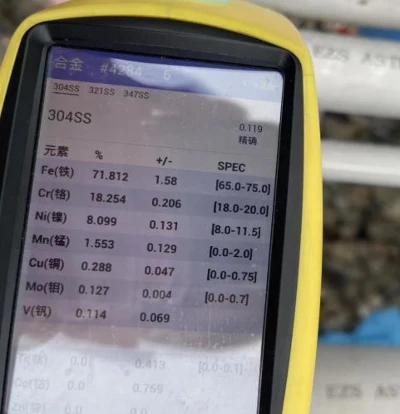
Inox 304 Chemical Composition Comparison (Typical Values)
| Element | AISI 304 / Inox 304 | EN 1.4301 (X5CrNi18-10) | JIS SUS304 | GB 06Cr19Ni10 |
| C | ≤ 0.08 % | ≤ 0.07 % | ≤ 0.08 % | ≤ 0.08 % |
| Si | ≤ 1.00 % | ≤ 1.00 % | ≤ 1.00 % | ≤ 1.00 % |
| Mn | ≤ 2.00 % | ≤ 2.00 % | ≤ 2.00 % | ≤ 2.00 % |
| P | ≤ 0.045 % | ≤ 0.045 % | ≤ 0.045 % | ≤ 0.045 % |
| S | ≤ 0.030 % | ≤ 0.030 % | ≤ 0.030 % | ≤ 0.030 % |
| Cr | 18.0 – 20.0 % | 17.5 – 19.5 % | 18.0 – 20.0 % | 18.0 – 20.0 % |
| Ni | 8.0 – 10.5 % | 8.0 – 10.5 % | 8.0 – 10.5 % | 8.0 – 11.0 % |
| N | ≤ 0.10 % | ≤ 0.10 % | - | ≤ 0.10 % |
Inox 304 Mechanical Properties
Annealed / Solution-Treated Condition
| Property | ASTM A240 (plate) | EN 10088-3 (bar, d ≤ 160 mm) |
| Tensile Strength (Rₘ) | ≥ 515 MPa (75 ksi) | 500 – 700 MPa |
| Yield Strength (Rp0.2) | ≥ 205 MPa (30 ksi) | ≥ 190 MPa |
| Elongation (A₅) | ≥ 40 % | ≥ 45 % |
| Hardness (max) | ≤ 201 HBW / ≤ 92 HRB | ≤ 215 HBW |
What is the hardness of Inox 304?
Inox 304 (AISI 304 / 1.4301) has a typical hardness of 70 to 92 HRB on the Rockwell B scale, 140 to 215 HB on the Brinell scale, and roughly 140 to 160 HV on the Vickers scale. It is a relatively soft, ductile austenitic stainless steel that cannot be hardened through standard heat treatments, though its hardness increases through cold working.
Inox 304 Cold-Worked (Work-Hardened) Condition
| Condition | Rp0.2 (MPa) | Rₘ (MPa) | A₅ (%) | Hardness |
| 1/4 Hard (25 % CW) | ≥ 415 | 600 – 850 | ≥ 25 | ~ 120 HRB |
| 1/2 Hard (50 % CW) | ≥ 620 | 700 – 950 | ≥ 15 | ~ 150 HRB |
| Full Hard (70 % CW) | ≥ 830 | 800 – 1050 | ≥ 10 | ~ 170 HRB |
Inox 304 Physical Properties (at 20 °C)
| Property | Value |
| Density | 7 900 kg/m³ (7.9 g/cm³) |
| Elastic Modulus (E) | 193 – 200 GPa |
| Shear Modulus (G) | 74 – 81 GPa |
| Poisson's Ratio | 0.29 |
| Thermal Conductivity (20 °C) | 15 W/(m·K) |
| Thermal Conductivity (100 °C) | 16.3 W/(m·K) |
| Thermal Conductivity (500 °C) | 21.5 W/(m·K) |
| Specific Heat (0–100 °C) | 500 J/(kg·K) |
| Melting Range | 1 400 – 1 450 °C |
Inox 304 Thermal Expansion Coefficient (α, × 10⁻⁶ /K)
| Temperature Range | α |
| 20 – 100 °C | 16.0 |
| 20 – 200 °C | 16.5 |
| 20 – 300 °C | 17.0 |
| 20 – 400 °C | 17.5 |
| 20 – 500 °C | 18.0 |
| 20 – 800 °C | 19.0 |
Inox 304 Elastic Modulus vs. Temperature
| Temperature (°C) | E (GPa) |
| 20 | 200 |
| 100 | 194 |
| 200 | 186 |
| 300 | 179 |
| 400 | 172 |
| 500 | 165 |
Related / Near-Equivalent Grades
| Grade | UNS | EN | Key Difference | Typical Use |
| 304L | S30403 | 1.4307 (X2CrNi18-9) | C ≤ 0.030 % | Welded sections > 6 mm; food/pharma |
| 304H | S30409 | 1.4948 | C 0.04–0.10 % | High-temperature creep service (> 525 °C) |
| 316 | S31600 | 1.4401 (X5CrNiMo17-12-2) | + 2–3 % Mo | Marine, chemical, chloride environments |
| 316L | S31603 | 1.4404 (X2CrNiMo17-12-3) | C ≤ 0.030 % + Mo | Welded marine/chemical service |
| 430 | S43000 | 1.4016 (X10Cr17) | Ferritic, no Ni | Appliances, architectural trim |
Does inox 304 rust?
While 304 stainless steel offers some protection against rusting, this does not mean it is entirely immune to oxidation. It can corrode over time when exposed to certain conditions-such as high humidity or salt water.
What is the difference between 201 and 304 inox?
Composition: 201 sheet has a high metal content, a bright exterior with a dark brightness, and is easy to rust. 304 contains more chromium, has a matte finish, and it does not rust. The content is another significant distinction between 201 and 304.
What is the difference between inox 304 and SS304?
Inox 304 and SS304 refer to the same material-"Inox" is the French abbreviation for stainless steel, while "SS" stands for "Stainless Steel" in English. Both denote 18-8 chromium-nickel austenitic stainless steel, with identical chemical composition, properties, and compliance with standards like ASTM A240.
Inox 304 vs. 316: Key Differences
Both inox 304 and inox 316 stainless steels are austenitic stainless steels that offer good formability, weldability, and corrosion resistance, though they differ in their chemical composition. inox 304 stainless steel typically contains 18%–20% chromium and 8%–10.5% nickel, whereas inox 316 stainless steel contains 16%–18% chromium, 10%–14% nickel, and 2%–3% molybdenum. inox 304 is generally more economical for use in kitchen equipment, food processing, and general manufacturing, while inox 316 is better suited for environments where the presence of chlorides increases the risk of corrosion.
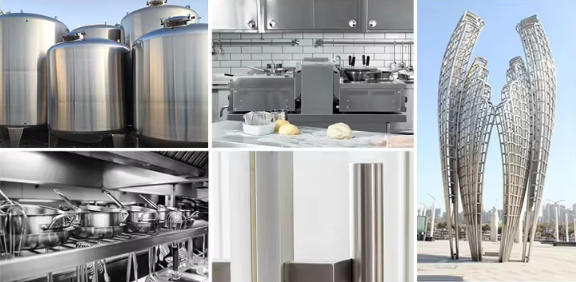
Applications of 304 Stainless Steel (Inox 304 / 1.4301)
Food and Beverage Industry: Food storage tanks, brewing equipment, juice transport piping, kitchen utensils, and food processing tables. Suitable for environments involving contact with weak organic acids and routine cleaning procedures.
Water Treatment and Piping Systems: Potable water piping, water tanks, and heat exchanger shells. Suitable for freshwater environments, but not for saline environments with high chloride ion concentrations.
Architecture and Decoration: Handrails, exterior wall panels, decorative profiles, and elevator cladding. Suitable for inland locations; in coastal areas, the impact of salt-spray corrosion must be considered.
General Chemical Industry: Containers for storing weak acids or dilute alkaline solutions. Not suitable for environments with high concentrations of chlorides or hydrochloric acid.
Are you looking to use Inox 304 for a specific project, manufacturing task, or home application? Let me know so I can share advice on fabrication, welding, or whether a different grade (like 316) is a better fit.
GNEE – Your Trusted Supplier of Inox 304 and Global Equivalents
At GNEE Steel, we supply a wide range of Inox 304 stainless steel products including coils, sheets, plates, bars, and pipes - all with traceable certifications and available in international equivalents like 1.4301, SUS 304, and UNS S30400.
✅ We Offer:
Full stock of Inox 304 / 1.4301 / SUS 304 materials
Customized cutting, slitting, polishing, and fabrication
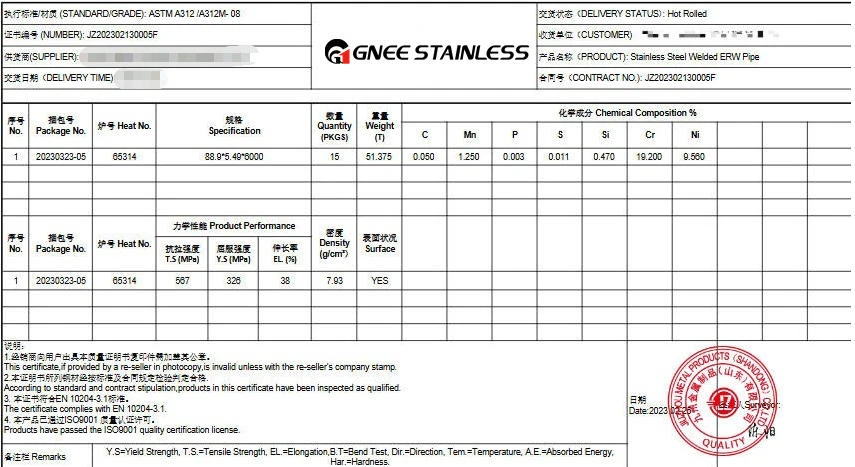
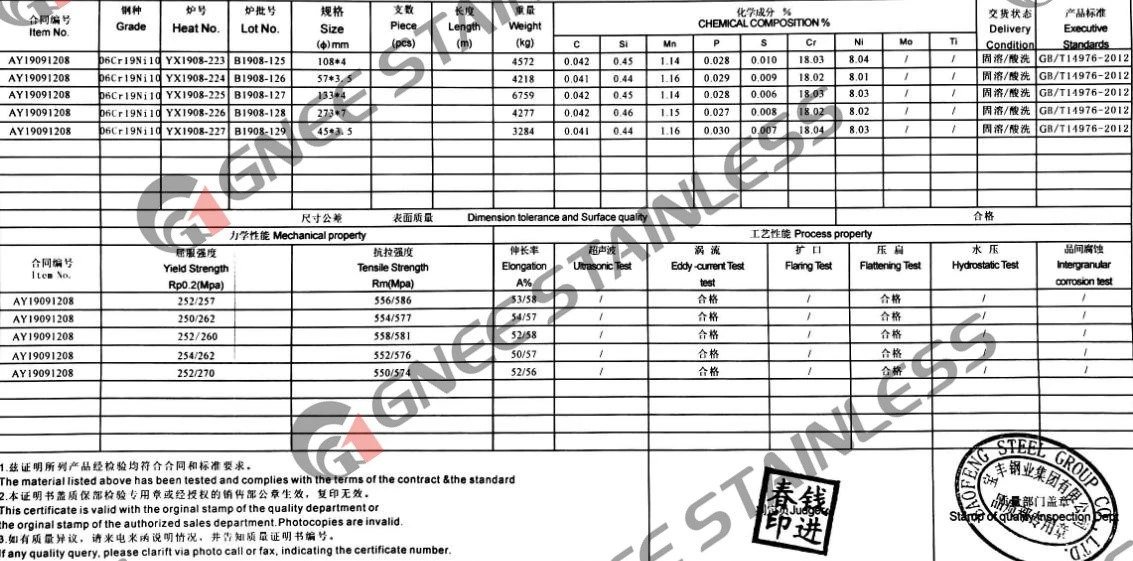
Mill test certificates (EN 10204 3.1/3.2)
Export packaging and global shipping (Europe, Asia, South America)
Competitive pricing and prompt delivery
📩 Contact us today to get a quote or request material datasheets. Whether you need EN 1.4301 stainless steel coil or JIS SUS 304 sheets, GNEE has the expertise and inventory to meet your needs.


GNEE provides a material test certificate (MTC) with every order, including chemical composition, mechanical properties, heat number traceability, and compliance with the specified ASTM, EN, or JIS standards; EN 10204 3.1 or third-party-inspected 3.2 certification is available according to project requirements.